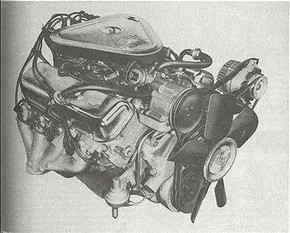
The year 1970 was an important time for General Motors. Chevrolet announced the expansion of its legendary Mark IV block line with a massive 454 cubic-inch engine. This new powertrain is available across the Monte Carlo, Chevelle, full-size Chevrolet sedan and Corvette lineup. But a look at the same year’s specs reveals a perplexing duality. The 400 cubic-inch model had two different engines. They share a name but nothing else. One is a bloated derivative of the big-block 396, the other a compact unit rooted in the thick-webbed architecture of the 350, which itself traces its lineage to the famous 327.
Small-Block 400: a compromise on paper
Chevrolet engineers had to break several design rules to squeeze 400 cubic inches out of the tiny V-8 architecture. The restrictions are strict. This small block has a 4.40-inch bore spacing and a short deck height. These dimensions severely limit stroke length. If the stroke is too long, there is a risk that the piston will fall completely out of the cylinder bore.
To achieve this displacement, they bored the cylinders to 4.125 inches in the cylinder. This leaves less than a quarter inch of metal between the holes. There is no space for the water jacket to separate the cylinders. This technique, known as siamesed bores, eliminates the cooling channels between the cylinders, saving space and weight. However, this creates a thermal management nightmare.
The stroke was also extended from 3.48 inches on the 350 to 3.75 inches. This requires a larger main bearing (2.65″ diameter instead of 2.45″). Larger bearings ensure proper overlap between main journals and crankpin. Therefore, the team had to design a new crankshaft that was heavier and stronger.
As the stroke lengthens, the speed of the piston increases. Combined with the inability of siamesed cylinders to dissipate heat effectively, the engine becomes very sensitive to thermal stress. The result? The small-block Turbo-Fire 400 had little potential as a high-performance engine. Its main advantage is emissions control. The geometry provided a more favorable surface-to-volume ratio, which promotes stronger combustion of hydrocarbons. Still, Chevrolet’s maximum output from this engine is only 265 horsepower.
Big Block Turbojet 400 and 454
The Turbo-Jet 400 tells a completely different story. This device is part of the Mark IV block series. The cylinder dimensions are almost identical to the small-block variant (4.126 x 3.76 inches), but its performance characteristics are superior. In 1970, this big-block produced a mighty 330 horsepower with a compression ratio of 10.25:1.
the 454 launched in the same year. This is essentially a Mark IV model with stroke extended to 4.00 inches. 454 is available in two flavors.
- LS-5: Rated power is 390 horsepower. This version featured a hydraulic lifter, 10.25:1 compression ratio and a four-barrel Rochester carburetor.
- LS-7: Rated power is 460 horsepower. This is a high performance option. It uses solid lifters, raises the compression ratio to 11.25:1, and is equipped with a 4-barrel Holley carburetor. A special higher-lift camshaft and transistor ignition system are also used.
End of an era
These big blocks represent the pinnacle of Chevrolet performance engine development. They are potent and easily move heavy machinery. But they face an immediate threat. These high compression, high output power plants are not suitable for anti-smog devices mandated starting in 1973.
Emission standards are being tightened rapidly. America is about to experience its first “fuel shock”. This period eventually leads to the oblivion of large performance cars.