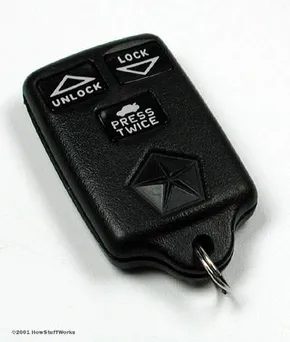
We make magic with the small plastic fobs of our key chains. Press the button. The door opens. Simple. Is your garage remote hanging from your visor? It’s the same thing. Open. Close. Done. We don’t usually think about the radio waves flying between our thumb and the receiver in our car or garage door opener.
These are more than just switches. These are radio transmitters.
When you press the button, the device wakes up and sends a specific code to the corresponding radio receiver. The car’s receiver is tuned to the exact frequency. In modern systems this is typically 300 or 400 MHz. The same applies to garage units. Listen for certain signals. Otherwise, ignore.
Think of your key fob as a small walkie-talkie. It sends. The car or garage hears. If the codes match, the lock will open or the motor turns. This technique is simple and old-fashioned, but necessary for modern comfort. Without this wireless link, you’re back to the physical keys in doors. Even worse, you might have to guessing where you left your garage door opener.
The key fob is basically a small radio transmitter that sends a coded signal to a 300 or 400 MHz tuned receiver.
Some home security setups use similar remote controls. You might see it if you look around. However, they are not as common as car or garage versions. The basic principles remain the same. Transmission. reception. Verification. Action.
It resembles the operation of radio-controlled toys. You grab the controller. The toy responds. The physics are identical. But the scale is different. There are also different codes. Safety is important. You don’t want your neighbor’s remote opening your trunk. That’s why the code is unique. Or rolling. Or encrypted. That is for another time.
For now, just know that every time you press the button, something flies through the air. Radio waves. Carrying a command. Unlocking your day.
Garage door openers in the early 1950s were very simple. The transmitter sends a single unencrypted signal. When the receiver hears the sound, the motor starts. Open or close. That was it.
As these devices become the norm on suburban driveways, this simplicity becomes a major vulnerability. Anyone with a compatible transmitter can drive past a house and open the garage. They all operate on the same frequency. There are no protective layers. That’s raw RF power.
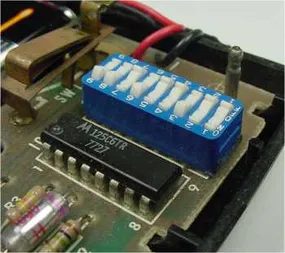
In the 1970s, engineers added layer of sophistication to existing equipment. You can see how it works in photos of internal components from this era. The black controller chip is next to the blue DIP switch package.
A DIP switch consists of eight small toggle switches soldered directly to the circuit board. These can be manually configured on the handheld transmitter. This physical configuration determined the code broadcast. The receiver’s DIP switch must match that exact pattern. Only then does the garage door activate.
Why 256 combinations are not secure enough
This system provides the basis for privacy. kept casual neighbors from accidentally triggering each other’s doors. But it cannot provide real security.
Mathematics is merciless. Eight DIP switches offer exactly 256 combinations. This is a tiny pool for cryptographic security. A determined attacker can cycle through every code in a matter of minutes. This system is protected against ignorance. It defenseless against persistence.
“Eight DIP switches only have 256 possible combinations… not enough to guarantee real security.”
Although the hardware is constantly evolving, there are still fundamental flaws. Physical settings versus digital encryption. Although moving to rolling codes would eventually solve the problem, for many years the garage was only as safe depended on the neighbor’s ignorance.
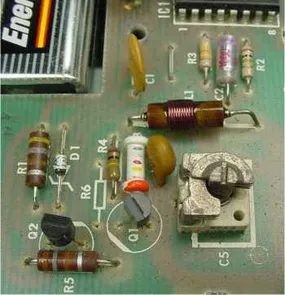
Those garage door openers from the early 1970s relied on transmitters that were brutally straightforward. Look at the circuit board. You see two transistors. A few resistors. That is basically it. Powered by a single nine-volt battery, this two-transistor setup represents the absolute floor for radio transmitter complexity. It is the same fundamental architecture you find inside a cheap pair of walkie-talkies sold for ten dollars today. It works. It is reliable. It is also dangerously simple.
Remote-entry technology has not stayed static. The gap between those rudimentary circuits and what we use now is vast. To understand why your garage is safer (or more complex) today, we have to look at the modern equivalent of that simple box.
How Modern Garage Door Openers Work Differently
The shift wasn’t just about adding more parts. It was about adding intelligence. Early units operated on fixed codes. If you could hear the frequency, you could replicate the signal. Modern systems use rolling codes or encrypted digital signals. This means every time you press the button, the transmitter and the receiver generate a new, unique code sequence.
The core difference lies in security: fixed codes can be copied; rolling codes change with every use.
This evolution answers the “how” of modern entry systems. They no longer just shout a static frequency into the void. They negotiate. They authenticate. The hardware inside your car’s key fob or wall-mounted keypad is no longer a simple oscillator circuit. It is a microcontroller running complex algorithms.
Why Simplicity Was Both a Strength and a Weakness
The simplicity of the 1970s transmitter had an upside. If it broke, you could fix it with basic tools and a schematic. The downside was security. Anyone with a basic radio scanner and a bit of soldering iron could lift the signal. Today’s systems prioritize security over ease of repair. You cannot easily dissect a modern encrypted fob to understand the logic. The complexity is the point.
So, which system is better? The simple one that you can fix at home or the complex one that keeps out hijackers? The answer depends on what you value. Security usually wins in the long run. But the elegance of the two-transistor design remains a testament to minimalist engineering.
Where Technology Heads Next
We are moving toward even more integrated systems. Bluetooth Low Energy (BLE) and NFC are starting to replace traditional RF signals in premium vehicles. The hardware is becoming smaller, more efficient, and harder to replicate. Yet, the core principle remains the same. Send a signal. Receive a signal. Open the door. The journey from two transistors to microchips is a long one. And it is still evolving.