


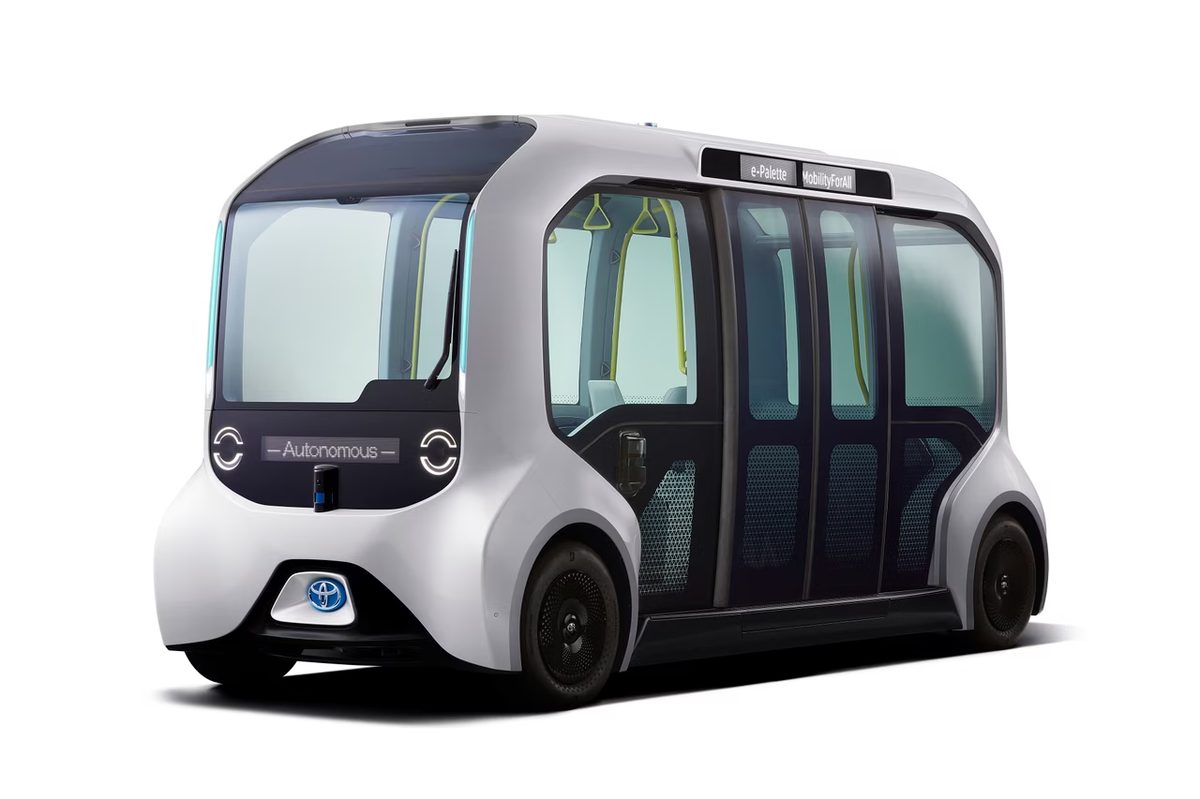
Toyota hasn’t just improved its e-Palette for the Tokyo Olympics. They completely redesigned the interior. Next year, 20 state-of-the-art electric shuttles will transport athletes and support staff between the Olympic Village and the Paralympic Village. The goal is simple. Move people. Efficiently. Safely. Inclusively.
The capsule vehicle debuted in 2018, but at the time it was still just a concept. A glimpse into the future of driverless driving. Now this is a practical reality. The design prioritizes accessibility. Large doors. Electric ramps. These are not optional accessories. These are the foundation of the chassis.
Inside the cabin is an open box. There are no fixed rows of seats to block the flow of people. Instead, railings are installed along the walls. A seat that can be easily folded and stored. Guidance lines on the floor. Why choose high-contrast colors? Visual clarity. The finishes vary greatly in color and tone. This allows visually impaired or color blind people to navigate the space without confusion.
“Accessibility features are based directly on information about the mobility needs of athletes, especially Paralympic athletes.”
Toyota doesn’t guess what these users want. they asked. The athletes gave feedback. Their specific mobility requirements defined the final interior. The result is a vehicle with something for everyone. People cannot walk freely. People who use wheelchairs or other assistive devices.
The focus on automation is in line with our broader vision for the 2020 Olympics. Transport should be seamless. Invisible. But very effective. These e-Palettes are more than just shuttles. They are statements. Proof of inclusive design in the age of self-driving cars.
Can e-Palette accept air taxis?
The e-Palette travels independently along a fixed route at a speed of about 20 km/h. It’s very slow. They do it on purpose. However, the backup driver was included just in case. The shuttle can accommodate up to 20 people if the additional seats are full. This is not a sports car. This is a mobile room.
The most important thing is the technology stack. Toyota didn’t skimp on the sensors. There are cameras everywhere. It also has LiDAR. This is a lidar that maps the world in 3D in real time. Highly accurate map input system. The same goes for 360 degree views. Software and hardware work together to cover all dead spots.
This is not just a bus with a hidden driver’s seat. This is its own independent platform. The question is not whether cars can drive themselves or not. The question is whether it can compete with the vertical climb. Air taxis guarantee speed. Electronic pallets promise integration. Access to the country. No need for a helipad. It’s just one station.
Why soil matters
Most people believe that flying cars are the future of urban transportation. It’s lovely. They grab the headlines. But they need infrastructure that we don’t have. Vertical ascent and descent. Noise regulations. Air traffic control on low flights. Electronic pallets avoid all this. It uses existing roads. Existing stop. Current traffic rules. to a large extent.
The 20 km/h speed limit is a safety feature, not a restriction. In dense urban areas, slower is safer. Pedestrians take longer to react. This reduces the severity of potential collisions. Sure, it’s boring. But boredom can keep a person alive.
Comparison with air taxi. They can start at a faster pace. The height will be higher. The costs are higher. e-Palette is aimed at short, high-frequency routes. airport shuttle. Pickup on campus. Last mile connection. We’re not trying to crash the helicopter. I am looking for a replacement for my minivan.
Human factors
Yes, we have a driver. But don’t imagine a traditional driver. This person is a security inspector. If the sensor fails, control can be taken over. If the map data is incorrect. If your dog runs out into the road. The system is designed to handle 99% of cases without human input. The driver is your backup.
The most important thing is that it can accommodate 20 people. This is not a taxi. This is a small bus. This is not a limo. This is a shared journey. The economy only works if we fill the seats. High utilization rate. Low cost per passenger. This is a model.
The 360-degree view isn’t just for show. Provides information to autonomous driving systems. Cameras deal with color. LiDAR deals with distance. A very precise map processing context. Are there lane markings? A stop sign? Construction zone? All this is known before the vehicle arrives.
Where do the Air Taxis leave from here?
It will be many more years before flying taxis become common. regulating wall. battery density. recognized. Electronic pallets are now available. Currently being tested. We are conducting a pilot in a limited area. The technology has matured. The problem is adoption.
Do cities allow such slow, voluntary closures?
Although Toyota is the official transport partner of the Tokyo Olympics, it does not have a monopoly on the future of urban transport. While the Japanese giant are front and center, there is some debate, both official and rumored, about whether athletes and spectators will actually be able to ride a flying taxi. This is not just hype. An aerial feasibility study for the 2024 Paris Olympics is already underway.
But before we look to the skies, ground-based solutions will make their first real public appearance. The e-Palette shuttle will be presented at the Tokyo Motor Show from October 23 to November 4. This is more than just a concept car on a rotating platform. It is a purpose-built electric vehicle designed for shared mobility in dense urban environments. The exhibition in the capital gives the public the opportunity to get to know Toyota’s vision of urban transport in the next decade.


