The hybrid car market is undergoing a shift, with plug-in hybrids (PHEVs), dubbed “Super Hybrids,” challenging traditional models. While Toyota has long dominated the hybrid space with vehicles like the Prius and RAV4, the MG HS Super Hybrid is now aggressively competing for family buyers. This contest highlights the changing landscape where over 100km of electric range combined with efficient internal combustion engines (ICE) is becoming the new standard.
The Hybrid Evolution: From Niche to Mainstream
Hybrid technology isn’t new. The Honda Insight pioneered the segment in 2001, but Toyota expanded hybrid offerings, and now, plug-in hybrids are rewriting the rules. These PHEVs offer over 100km of electric range and a total reach of 800km or more, combining the benefits of electric and gasoline power. Unlike traditional hybrids, PHEVs can be charged from standard outlets, offering flexibility for daily commutes.
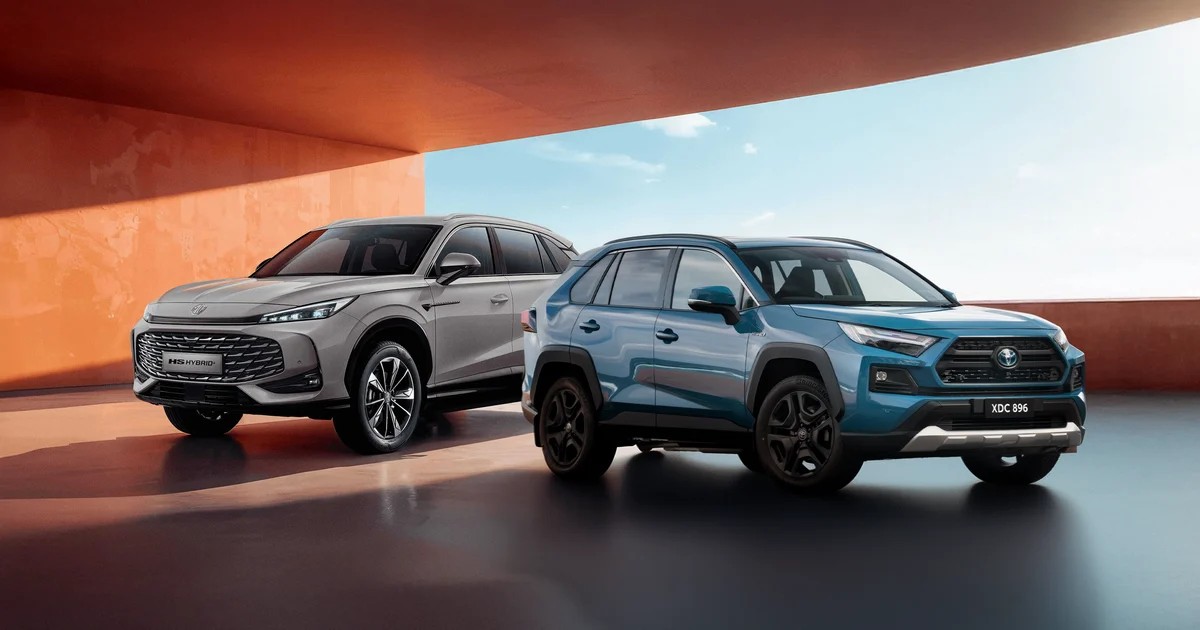
The Contenders: MG HS vs. Toyota RAV4
The mid-size SUV market is particularly competitive, and the Toyota RAV4 has been the benchmark. However, the MG HS Super Hybrid is emerging as a serious challenger, offering a compelling blend of efficiency and affordability. Both models target families seeking a greener driving experience, but with different approaches.
Price and Value: MG Takes the Lead
Hybrids traditionally command a premium, but MG is disrupting this with its HS Essence Super Hybrid. Priced at $52,990 drive-away, it undercuts the Toyota RAV4 Cruiser AWD, which starts at $54,410 before on-road costs. The base HS Hybrid starts at $33,990, with the HS Excite Hybrid at $42,990. Toyota’s next-generation RAV4 will include PHEV options but with expected price increases.
Features and Equipment: A Close Match
Both SUVs are well-equipped. The RAV4 Cruiser includes a sunroof, nine-speaker sound system, and partial leather seats. The MG HS Essence counters with larger 19-inch alloys, a kick-to-open tailgate, a 360-degree camera, a 12.3-inch infotainment screen, and electric adjustment for the front passenger seat. Both share standard features like keyless entry, automatic LED headlights, heated mirrors, satellite navigation, wireless Apple CarPlay/Android Auto, DAB+ radio, wireless charging, heated seats, dual-zone climate control, and 60:40 split rear seats.
Safety: ANCAP Ratings and Advanced Systems
Both models hold a five-star ANCAP safety rating. However, MG’s rating currently applies only to non-hybrid versions, which may not change for Super Hybrids. The RAV4’s rating is from 2019, predating newer ANCAP protocols. The MG offers lane-change assistance, speed-limit assistance, and a driver attention monitor, while both have adaptive cruise control, autonomous emergency braking, blind-spot monitoring, lane-keeping assistance, and rear cross-traffic alert.
Interior Comfort and Design
Both the HS and RAV4 provide comfortable interiors with ample storage and USB ports. The Toyota’s interior shows its age with a smaller, awkwardly positioned infotainment screen compared to the MG’s modern twin-screen setup. The MG also features a flattened steering wheel for improved visibility. However, Toyota’s build quality and switch operation feel more refined.
Powertrains: Efficiency and Performance
The RAV4 uses a 2.5-liter four-cylinder petrol engine with an 88kW electric motor, delivering 163kW of power and 221Nm of torque. Toyota claims 4.8L/100km fuel consumption and 109g/km CO2 emissions. The MG HS Super Hybrid combines a 1.5-liter engine with a 155kW electric motor, producing 220kW and 350Nm. MG claims 0.7L/100km fuel consumption and just 17g/km CO2 emissions, thanks to its larger 24.7kWh battery. The HS can be charged in 7.3 hours from a standard outlet but doesn’t support DC fast-charging.
Cost of Ownership: MG’s Advantage
The MG HS Super Hybrid offers a cost advantage if regularly charged, effectively functioning as an EV for most daily commutes. The average Australian commute is around 40km, well within the HS’s 120km electric range. Toyota hybrids have limited EV-only capability. Toyota offers a five-year unlimited-kilometre warranty with 12-month/15,000km service intervals, costing approximately $1300 over the warranty period. MG provides a seven-year unlimited-kilometre warranty, extendable to 10 years with dealer servicing. The HS battery also has a seven-year warranty.
The Verdict: MG HS Super Hybrid Wins This Round
The MG HS Super Hybrid emerges as the winner, offering superior plug-in hybrid technology and cost of ownership. It provides a compelling combination of electric range and gasoline backup, making it ideal for drivers seeking a greener option without range anxiety. Toyota’s upcoming PHEV RAV4 will likely close the gap, but for now, the MG HS Super Hybrid represents exceptional value.
This contest demonstrates how quickly the hybrid market is evolving, and the MG HS Super Hybrid is at the forefront of this transformation.