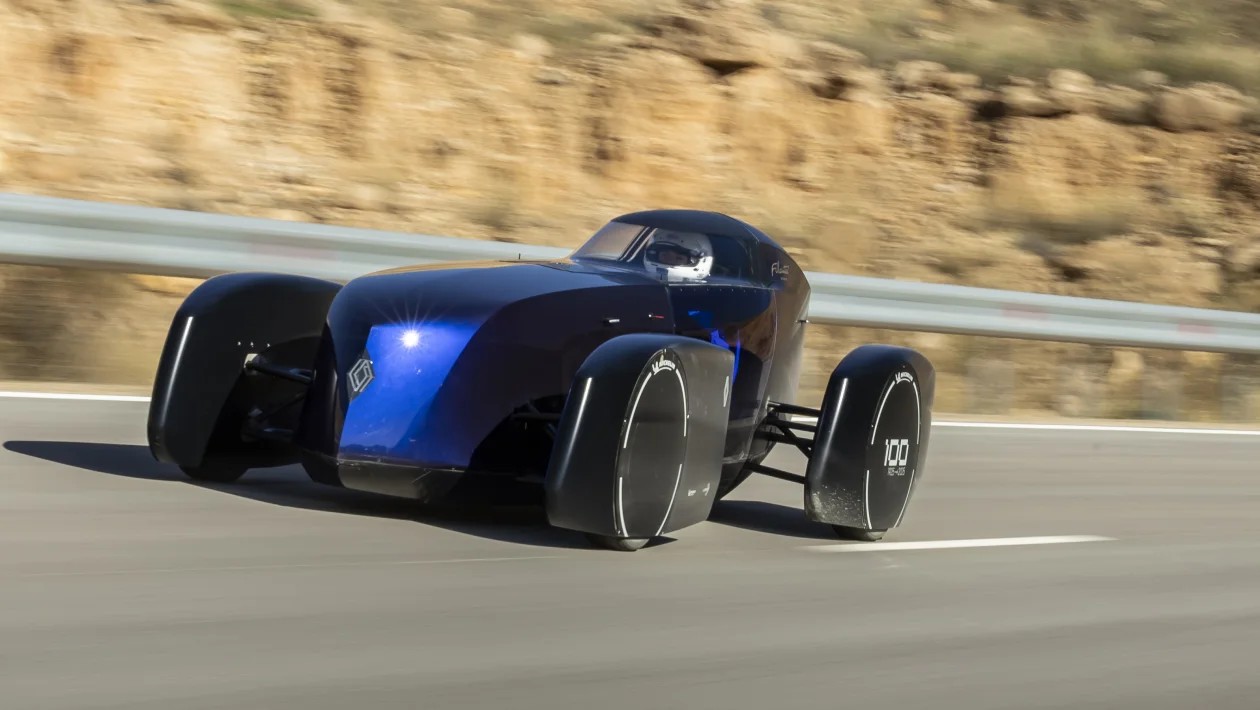
Renault has shattered expectations in electric vehicle (EV) efficiency, achieving a remarkable 1,000 kilometers (621 miles) of range at sustained highway speeds on a single charge with its experimental Filante Record 2025. This feat, verified in real-world conditions, sets a new benchmark for EV technology and highlights the potential for long-distance electric travel.
Pushing the Boundaries of EV Performance
The Filante Record 2025, unveiled in early 2025, is not intended for production but serves as a high-tech laboratory to explore extreme aerodynamic and electric powertrain capabilities. Inspired by Renault’s historic land speed record vehicles from the 1920s and 1950s, the car was designed to maximize efficiency without compromising speed. Unlike some endurance tests that prioritize minimal energy use, the Filante was driven at an average speed exceeding 68 mph (110 km/h).
Key Achievement: The vehicle completed the 1,000km run with 11% battery capacity remaining, enough for an additional 75 miles of high-speed driving. This translates to an average energy consumption of 8.0 miles per kWh—twice as efficient as recent tests involving the Mercedes CLA and Tesla Model 3.
Technological Innovations
The Filante Record 2025 achieves this performance through several key innovations:
- Aerodynamic Design: The car’s streamlined silhouette minimizes drag, with a drag coefficient estimated to be comparable to the ultra-efficient Mercedes EQXX (around 0.17). The bodywork is sculpted to reduce turbulence, with wheel fairings inspired by Renault’s historical speed record cars.
- Efficient Tires: Custom-designed Michelin tires reduce rolling resistance by approximately 40% compared to conventional tires.
- Advanced Powertrain: The vehicle utilizes an 87 kWh battery—the same size as the Renault Scenic SUV’s—paired with cell-to-pack technology for improved efficiency, reduced weight, and optimized space utilization.
- Steer-by-Wire and Brake-by-Wire: Eliminating mechanical connections reduces weight and allows for more flexible vehicle design, potentially improving accessibility for drivers with limited mobility.
Historical Context and Future Implications
Renault’s pursuit of efficiency echoes the company’s early efforts in land speed records with vehicles like the 1925 Renault 40CV ‘des Records.’ The Filante Record 2025 builds on this legacy, demonstrating how aerodynamic refinement, lightweight construction, and advanced powertrain technologies can significantly extend EV range.
While the Filante itself will not enter production, the data and technologies developed during its testing will directly inform future EV designs. Renault plans to integrate these learnings into upcoming models, aiming to achieve higher efficiency levels in real-world driving conditions, including high-speed motorway travel.
“This project was born from an obsession: achieving record-breaking efficiency,” says Olivier Blanche, Renault’s concept car project manager. “We battled the weather and aerodynamics, but what stands out most for me is the human adventure: an incredibly motivating collective challenge, driven by the dedication of the Renault teams and all our partners.”
The Filante Record 2025 represents a significant step forward in EV technology, proving that long-distance, high-speed electric travel is not just feasible but achievable with the right combination of innovation and engineering.