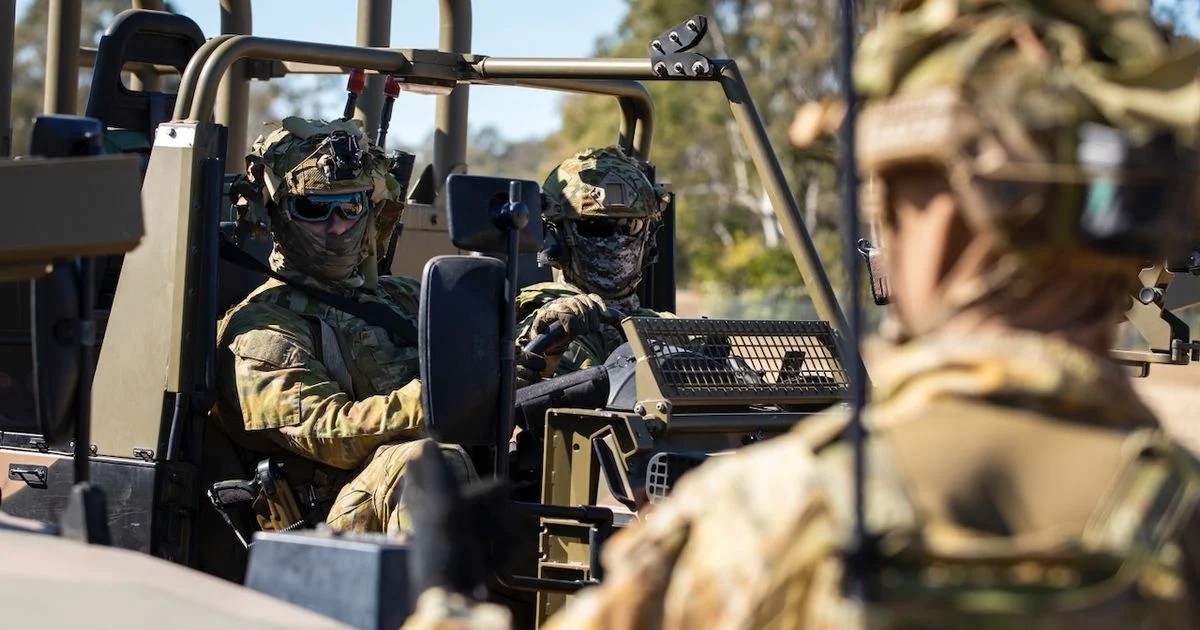
The reputation of the Australian Defence Force (ADF) as a formidable modern military is built upon the specialized capabilities of its Army, Navy, and Air Force. A critical component of this capability is the vehicle fleet—a diverse collection of machinery designed to ensure mission success and personnel safety in some of the world’s most challenging environments.
The ADF employs a dual-track procurement strategy: leveraging high-end equipment from global allies while utilizing Australia’s domestic engineering talent to design, modify, or manufacture bespoke solutions when standard off-the-shelf options do not meet specific operational requirements.
Light and Rapid Deployment Vehicles
For missions requiring high mobility and rapid deployment, the ADF utilizes smaller, more agile platforms.
Polaris DAGOR
The Deployable Advanced Ground Off-Road vehicle (DAGOR) serves as a high-performance, “grown-up” version of a utility task vehicle (UTV).
– Capacity: Can accommodate up to nine soldiers.
– Versatility: Features 48 different weapon configurations.
– Deployment: Its relatively light weight (~2000kg) allows it to be quickly transported via various military aircraft and helicopters.
– Power: Utilizes a multi-fuel diesel engine designed for rugged environments.
Mercedes-Benz G-Wagon
Replacing the long-serving Land Rover ‘Perentie,’ the Mercedes-Benz G-Class provides a robust backbone for various roles. The ADF utilizes 10 different variants, including three- and five-door wagons, single-cab and dual-cab utes, and even a 6×6 configuration.
– Specifications: Powered by a 3.0-litre turbo-diesel V6 (approx. 135kW/400Nm) with a five-speed automatic transmission.
– Legacy: While the transition from the Perentie took longer than anticipated due to fleet integration issues, the G-Wagon remains a cornerstone of ADF transport.
Specialized and Armoured Tactical Platforms
When the mission requires protection against high-threat environments, such as improvised explosive devices (IEDs) or ballistic fire, the ADF relies on heavy-duty armoured vehicles.
Supacat HMT Extenda
Used primarily by elite units like the Special Air Service Regiment (SASR) and the 2nd Commando Regiment, the UK-made Supacat is designed for long-range, high-risk missions.
– Design: A modular platform that can be configured with up to six wheels.
– Capability: Equipped with a 6.7-litre Cummins turbo-diesel engine (136kW/700Nm) and locking differentials for extreme off-road performance.
Hawkei
Manufactured locally in Bendigo, Victoria, the Hawkei is a light armoured patrol vehicle designed to replace older Land Rover variants.
– Performance: A seven-tonne mobile fighting platform powered by a 3.2-litre Steyr turbo-diesel (200kW/610Nm).
– Operational Profile: Features an eight-speed automatic transmission and a 600km range.
– Note: Despite its utility, the Hawkei has faced scrutiny regarding its procurement process and mechanical reliability.
Bushmaster Protected Mobility Vehicle
Perhaps the most internationally recognized of Australia’s military vehicles, the Bushmaster is an armoured troop carrier built by Thales in Bendigo.
– Protection: Originally designed for small-arms protection, it has proven exceptionally effective against IEDs and ballistic threats.
– Global Impact: Beyond its domestic use, over 120 units have been provided to Ukraine, where soldiers have praised its durability and even its climate control systems—a necessity for high-heat environments.
– Power: Driven by a massive 7.2-litre Caterpillar turbo-diesel engine (224kW/1166Nm).
Heavy Logistics and Transport
RMMV HX
To sustain large-scale operations, the ADF requires heavy-duty logistics. The Rheinmetall MAN Military Vehicles (RMMV) HX series provides this essential backbone.
– Scale: Approximately 3,600 trucks have been delivered since 2013, ranging from 4×4 to massive 10×10 configurations.
– Capacity: These heavy-rigid trucks utilize a 10.5-litre turbo-diesel engine (328kW/2100Nm) and can handle a gross combined mass of up to 44 tonnes.
Conclusion: The ADF’s vehicle fleet is a sophisticated blend of international technology and local innovation, ranging from rapid-response light vehicles to heavy-duty armoured troop carriers. This diversity ensures the military can project power and maintain logistics across a wide spectrum of combat and humanitarian environments.