The Nissan Primera’s final generation was more than just a family car; it was a symptom of a shifting automotive landscape. While it arrived during Nissan’s era of recovery under Renault’s influence, the model’s DNA was rooted in a much more turbulent period of the company’s history.
The “Flight to Premium” Challenge
To understand why the Primera struggled, one must look at the market trends of the late 1990s and early 2000s. This period saw what industry analysts called the “flight to premium.”
European buyers were increasingly moving away from mainstream brands and toward German luxury manufacturers like BMW, Mercedes-Benz, and Audi. This shift wasn’t just about prestige; it was driven by economics. Premium cars often held their value better, making them more cost-effective to lease—a crucial factor for the growing fleet market.
As corporate car policies evolved, employees (the “user-choosers”) were no longer forced into basic models like the old Ford Cortina. Instead, they demanded vehicles with status. For Nissan, competing against a BMW with a “double kidney grille” became an uphill battle.
The BMW Influence: P10 to P11
Nissan’s early strategy for the Primera was to borrow the aesthetic language of its German rivals to close this prestige gap.
- The P10 (1990): A significant step up from the uninspired Bluebird, the original Primera featured a sharper style and a highly praised chassis. It even adopted subtle BMW design cues, such as the “Hofmeister kink” in the rear side windows.
- The P11 (1996–2001): This generation followed a policy of incremental, consistent changes similar to BMW’s design philosophy. The 1999 facelift introduced Nissan’s “flying wing” twin grilles, which felt distinctly German.
While these cars were excellent drivers—evidenced by their British Touring Car Championship (BTCC) victories in 1998 and 1999 —they couldn’t quite bridge the gap for buyers who wanted true luxury.
The P12: A Radical Departure
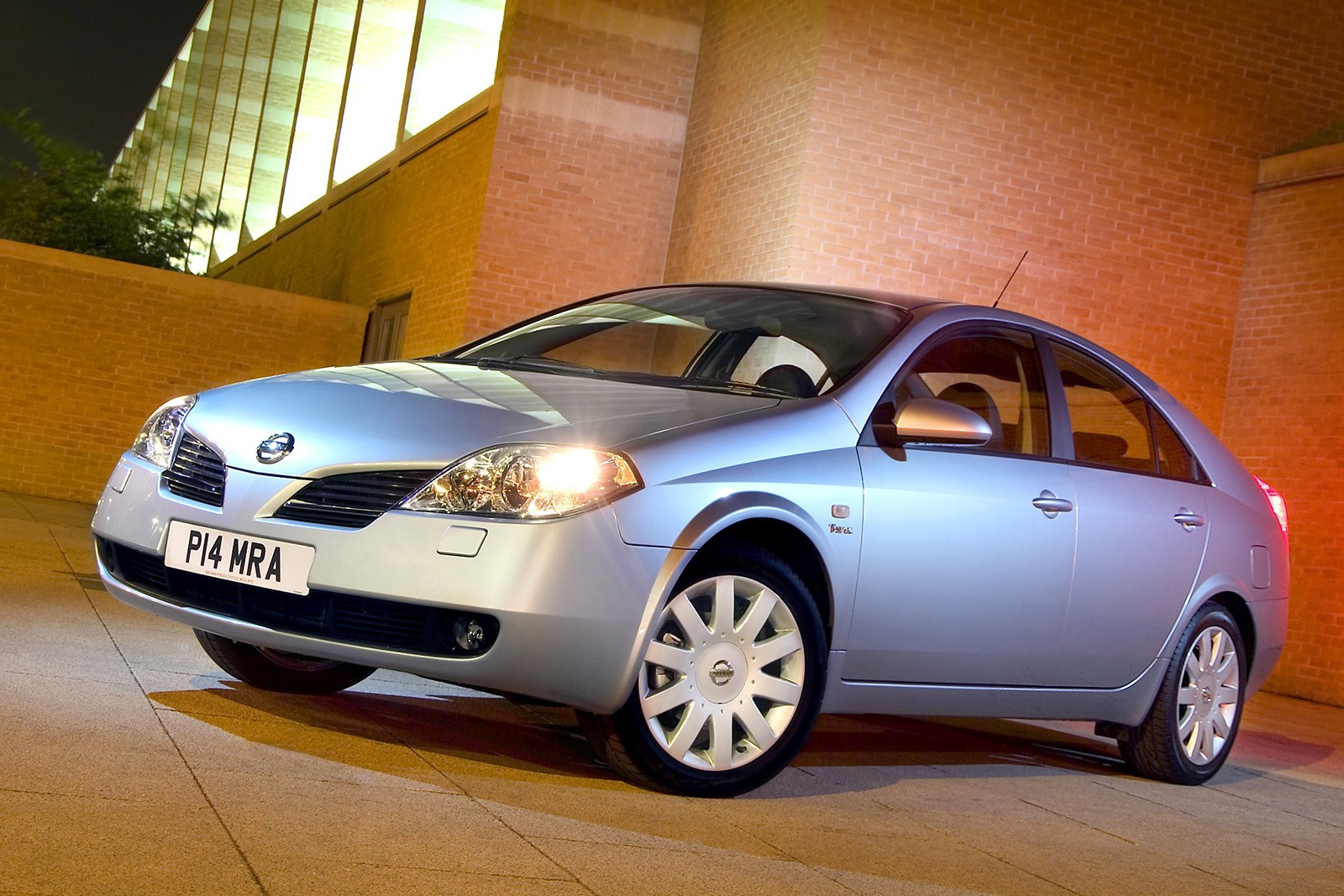
By the time the third generation (the P12) arrived in 2001, Nissan abandoned its imitation of German design in favor of something much bolder. Led by designer Stephane Schwarz, the goal was to create a car with a coupe-like silhouette without sacrificing the practicality required of a family vehicle.
The P12 moved away from the traditional saloon format, focusing instead on hatchbacks and wagons. This era introduced several key shifts:
- Space-efficient Design: Despite its sleek lines, the car maintained a large tailgate and a spacious cabin.
- Futuristic Interior: The dashboard moved away from traditional layouts toward a “spacecraft” architecture. This featured a central arc of instruments, a large central screen, and a horizontal deck of controls.
- High-Tech Focus: To compete with premium brands, Nissan packed the P12 with high-tech equipment and features that were considered novel at the turn of the millennium.
Conclusion
The evolution of the Primera reflects Nissan’s struggle to find its identity in a market obsessed with German prestige. By moving from BMW-inspired styling to radical, tech-heavy experimentation, Nissan laid the groundwork for the diverse, segment-defying vehicle lineup that would eventually lead to the success of the Qashqai.