


You probably know the bird as a symbol of power. Romans used it. Americans put it on currency. Car makers slapped it on everything from pencils to potato chips. Before World War I, six different automakers used the Eagle name. Four were in the U.S. alone. Durant Motors ran one in 1923-24. Chevrolet used it for deluxe trim in 1933. Dan Gurney’s All-American Racers used it for competition cars in the late ’60s. But none of that matters here.
The only Eagle that counts for modern automotive history is the one Chrysler pulled out of the ashes of American Motors Corporation.
Chrysler bought AMC from Renault in 1987. The real prize was the Jeep franchise. The Eagle name came with it as baggage.
How AMC’s Dealer Network Created the Eagle Division
Here is the problem Chrysler inherited. AMC had a dealer body. Those dealers sold cars and Jeeps. Jeep sales were rising. Car sales were not. Dealers needed cars to stay in business. So Chrysler didn’t just buy the trucks. They bought the whole ecosystem.
They rolled most AMC operations into a new division called Jeep-Eagle. Eagle became a full-fledged car make. The strategy was straightforward. Dodge and Chrysler-Plymouth covered the domestic market. Eagle would attack the imports. Target: Toyota, Honda, Nissan. Positioning: upscale. The hope was to steal customers who wanted Japanese reliability but preferred an American badge.
Did it work? No.
Which Cars Became the First Eagles?
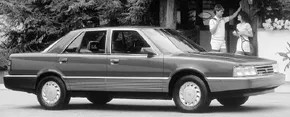
Jeep-Eagle opened for model-year 1988. The old AMC Eagles were dead. The tiny Renault Alliance and Encore were too problematic to save. That left two remnants of the Renault regime. Both were front-drive. Both were rushed to the U.S. just before the buyout.
- The Medallion : A compact four-cylinder. Basically a federalized Renault 21. It was a French import.
- The Premier : A midsize V-6 notchback. Based on the European Renault 30. Built in Canada. Styled by Giorgetto Giugiaro. Surprisingly dull.
They became Eagles by swapping badges. The new badge was handsome. The cars underneath were not.
Why American Buyers Rejected the Eagle Premier and Medallion
The cars were conventional for Renaults. For Americans? Too quirky. The fit and finish were lacking. The Medallion suffered most. Workmanship was wanting. It exited after 1989. A fast exit.
The Premier lasted longer. Through 1992. Why? Renault insisted. As part of the takeover deal, Chrysler had to keep building the car. It was a contractual obligation, not a market decision.
Chrysler tried. Really tried. Production peaked in calendar 1988 at about 59,000 units. Then sales went downhill. Fast.
In 1990, Dodge added a duplicate of the Premier. They revived the Monaco name. It didn’t help. The premise was flawed. You can’t badge-engineer your way into beating the Japanese with a French platform that feels foreign in the hands. The Eagle division was born from a merger of convenience, not strategy. And the cars were just good enough to be interesting, not good enough to sell.

Eagle Talon and Eagle Vision: The Front-Wheel Drive Twins
Chrysler needed to nail down the “import intender” demographic. People who wanted Japanese reliability but bought at a domestic dealer. So they leaned hard on Mitsubishi. The strategy was badge-engineering. Take a proven Japanese platform, slap an Eagle badge on it, and sell it as contemporary, accessible tech. Most of these cars stayed in Japan. The Summit sedan, a rebadged Mitsubishi Mirage from 1989, is the classic example. Even the short-lived Summit wagon — that weird early-90s “mini-minivan” based on the Expo LRV — rolled off lines overseas.
Then came the Talon and the Vision.
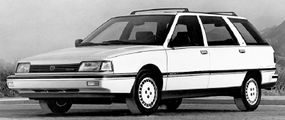
These weren’t just badge swaps. They were front-wheel-drive coupes and wagons derived from the Mitsubishi Cordia. The Talon was the coupe. The Vision was the wagon. Both shared the same DNA. Both targeted buyers who liked the sharp lines of Japanese design but wanted the dealer network of a Detroit automaker.
The Talon launched as a sporty compact coupe. It had that distinct 80s angularity. Pointy nose. Hatchback rear. It looked fast even when it wasn’t. The Vision took the same mechanicals and stretched them into a practical wagon. Not a minivan. A compact wagon. Think Golf GTI wagon but with Chrysler badging.
Why front-wheel drive? Cost. Packaging. And alignment with the Japanese partners. Mitsubishi knew FWD inside out. Chrysler was still figuring out rear-wheel drive complexity. The Talon and Vision offered a simpler, lighter package.
Powertrains varied. The base models got a 1.6-liter inline-4. Adequate. The higher trims got a 2.0-liter 4G63 engine. This is the one that matters. The 4G63 was Mitsubishi’s workhorse. It could take turbocharging. It was robust. Enthusiasts know this block. It became legendary in the AWD Eclipse GSX. In the Talon and Vision? It provided a nice shove without the complexity of a turbo kit.
The Vision wagon is the underappreciated gem here. It offered cargo space in a package smaller than the minivans flooding the market. It was agile. Handled better than a Voyager. Felt more like a car than a van.
These cars bridged a gap. Domestic buyers who wanted import styling. Import buyers who wanted domestic service. The Talon and Vision delivered both. They weren’t the fastest. They weren’t the most luxurious. But they were precise. Built to spec. Engineered for a specific niche that didn’t quite exist before.
The Eagle brand was trying to be something different. Not a luxury label like Imperial. Not a budget brand like Plymouth. A tech-forward, import-alternative brand. The Talon and Vision fit that mold perfectly.
They proved you could sell a Japanese-designed car with an American badge. And people bought them.

The Vision: Chrysler’s Failed Attempt at a Euro-Style Sedan
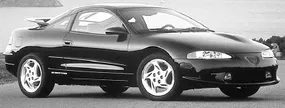
The Eagle Talon? Ignore it. It was a Mitsubishi Eclipse wearing different badges. Built in Illinois by that 50-50 Diamond-Star Motors joint venture, the Talon was sharp, especially in the AWD turbo form. But it was Japanese hardware. Not what we’re looking for.
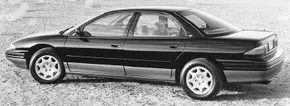
The first truly American Eagle arrived in 1993 with the Vision.
It rolled off the line in Canada, but the soul came from Detroit. This was part of the LH platform revolution—the “cab-forward” sedans that changed Chrysler’s styling language forever. The Vision wasn’t meant to be just another Concorde or Intrepid. It was supposed to feel European. How? Mostly through trim choices and styling cues, rather than a fundamentally different architecture.
You got two flavors. The ESi came with a 3.3-liter pushrod V-6. The TSi stepped it up with a twin-cam 3.5-liter V-6.
Was it a BMW? No. Don’t get it twisted. But for a domestic four-door, it handled. The LH chassis gave it a wide stance and all-independent suspension that felt crisp. The TSi didn’t skimp on brakes, packing four-disc antilock brakes as standard. By 1994, you even got speed-variable power steering. It was brisk. Responsive. Respectable, even if it wasn’t thrilling.
The interior space was the real surprise. That swoopy cab-forward design stretched over a long 113-inch wheelbase. Five adults fit inside without feeling like sardines.
The trade-off? Road noise.
It was annoyingly high. And some of the plastic trim looked cheap, fighting against the “premium” image Eagle was trying to sell. Still, Consumer Guide named it a “Best Buy.” It was a solid package on paper.
The market didn’t care.
Sales were pathetic. The Vision finished third in the LH lineup, trailing the Concorde and dragging far behind the Dodge Intrepid. It only moved 30 to 40 percent of the Intrepid’s volume. In 1993, they built roughly 30,000 units. That number stuck around the same level through 1995.
Why? Price.
Eagle dealers complained customers thought it was overpriced. Chrysler’s defense was classic corporate spin: the Vision came with more standard equipment than its siblings. Tell that to the buyer who saw the sticker price and walked away.
By the time the 1996 and 1997 models rolled out, production had collapsed. Combined sales for those two years? About 15,500 units.
They tried to keep it fresh. The ’96 ESi got bigger 16-inch wheels and Chrysler’s AutoStick feature, letting you nudge the automatic transmission into lower gears manually. A nice touch. But the ’97 model was a virtual rerun. Nobody cared. The Talon was dying too.
Chrysler pulled the plug. The Vision ended after 1997. The Talon followed in 1998. The Eagle nameplate, once a clever idea to capture the import market, simply failed.
The real story wasn’t the cars. It was the dealerships.
Chrysler wanted to cut overhead. They merged Jeep-Eagle stores with Chrysler-Plymouth outlets wherever they could. It was a smart move for the accountants. SUVs were booming. Jeep’s reputation was golden. The new combined dealerships made more money than the separate ones ever did.
The Eagle was gone. The balance sheet was happy.
Did anyone miss it? Probably not.

Why the Eagle Brand Never Gained Traction
Chrysler’s Eagle experiment stalled out because nobody quite knew what it was. The lineup felt like a hodge-podge. Promotion was spotty. It signaled that Detroit wasn’t fully committed to the badge. Consumers were left scratching their heads. What was an Eagle? Did it matter?
The metal itself wasn’t bad. These weren’t losers. But they lacked the sharp image of import rivals. They didn’t have the clear identity of even some domestic competitors. Eagle wasn’t an Edsel-level disaster. Still, it missed the mark. Chrysler forgot the lesson from Ford’s unhappy past. Respect for a car name isn’t given. It’s earned.
Other Defunct American Car Brands
Looking for more ghosts of the automotive past? Check out these names that faded away:
- AMC
- Duesenberg
- Oldsmobile
- Plymouth
- Studebaker
- Tucker


