


You’ve likely crossed paths with the name John Kanzius. He’s the 63-year-old former broadcast engineer who allegedly unlocked a way to burn saltwater. It sounds like science fiction. It sounds like a hoax. But the physics behind it are grounded in a very real, very strange discovery born from personal tragedy.
Kanzius didn’t set out to revolutionize the automotive industry. In 2003, he was diagnosed with leukemia. Facing the brutal reality of chemotherapy, he looked for a way to kill cancer cells without wrecking his healthy tissue. His solution was the radio frequency generator (RFG).
This device emits radio waves, focusing them into a tight, intense field. By injecting small metallic particles into a tumor, Kanzius could use the RFG to heat those particles. The heat destroyed the cancerous cells. The surrounding healthy tissue remained untouched. It was a promising medical breakthrough.
The Accidental Discovery
So, where does desalination come in?
During an RFG demonstration, someone noticed condensation forming on a nearby test tube. The radio waves were pulling moisture out of the air. If the machine could separate water from the air, could it separate salt from the ocean?
Desalination is the holy grail for arid regions. Nations are running dry. The world is 70% saltwater, yet most of that is undrinkable. An energy-efficient way to strip salt from seawater would be a game-changer for global water security.
Kanzius pointed his RFG at a tube of seawater to test the desalination theory.
What happened next wasn’t desalination. It was ignition.
The water sparked. Water doesn’t spark. It doesn’t burn. Yet there it was.
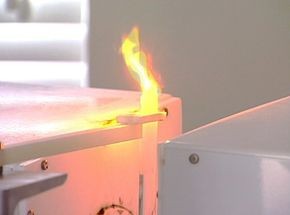
Kanzius repeated the test. This time, he touched a lit paper towel to the seawater while the RFG was active. The tube caught fire. It didn’t flicker out. It burned steadily, fueled by the radio frequency generator.
Skepticism and Science
Naturally, the internet called it a scam. Every tech blog and forum post screamed “hoax.”
Then Penn State University chemists got their hands on the machine. They ran their own tests. The results were undeniable. The RFG could indeed ignite saltwater. The flame reached temperatures up to 3,000 degrees Fahrenheit. It burned as long as the generator was on and aimed at the water.
The mechanism is rooted in chemistry, specifically hydrogen.
Normal saltwater is stable. You have sodium chloride dissolved in H2O. The bonds are strong. They don’t break easily. But radio waves disrupt that stability. The energy degrades the molecular bonds, releasing volatile hydrogen gas.
The RFG then provides the heat source to ignite that hydrogen.
The hydrogen burns indefinitely, as long as the water supply is replenished and the radio waves are active.
The Automotive Hurdle
It sounds like the perfect fuel source. Clean. Abundant. Infinite. So why isn’t your car running on saltwater yet?
The physics are sound. The engineering is tricky. The primary hurdle isn’t the science. It’s the application. Generating the massive amount of radio frequency energy required to keep an engine running efficiently is a monumental task. You need a compact, powerful RFG for every vehicle. You need a system that can handle the heat and the hydrogen release safely.
And then there’s the efficiency question. You’re putting electrical energy in to create radio waves, which break bonds, release hydrogen, which burns. That’s a multi-step energy conversion. The net energy gain has to make sense.
The promise is real. The flame is real. But getting this from a lab bench to a gas station pump is a different beast entirely.
We are only scratching the surface of what this technology can do. The next phase involves looking at how we actually integrate this into existing infrastructure.
The oil shocks of the 1970s woke us up to the fragility of fossil fuel dependence. That panic spawned a gold rush of inventors. Chemists. Engineers. Physicists. And plenty of charlatans. They all chased the same holy grail: an alternative that didn’t require drilling.
John Kanzius wasn’t the first to look at water and see a tank of gas. In 2006, a Florida firm called Hydrogen Technology Applications (HTA) launched Aquygen. The pitch was seductive. It claimed to split hydrogen from water using electrical impulses, then mix that hydrogen with standard gasoline. The result? A cleaner burn that supposedly boosted mileage by 1.5 times while cutting emissions.
HTA’s president, Denny Klein, put his money where his mouth was. He built a hybrid 1994 Ford Escort to prove it. The setup was clever in theory. The alternator generated electricity. That power split water molecules into hydrogen gas. The gas then fed directly into the fuel tank to mix with the gas.
But theory meets physics eventually.
The hydrogen HTA produced was volatile. Highly so. Mix that into a combustion chamber and you’re not just powering an engine; you’re handling a bomb. The safety risks were immediate and severe.
The Efficiency Trap
There was a deeper, more fundamental flaw in Aquygen. A flaw it shares with Kanzius’s Radio Frequency Generator (RFG). Both systems collapsed under the weight of the energy input-to-output ratio.
Here is the hard truth about physics. You cannot get more out than you put in. Most electrical or chemical processes dissipate energy as heat. To create a viable fuel source, the output must exceed the input. This is the difference between a power plant and a candle.
The RFG produced a stable hydrogen flame. It looked promising. But the energy required to generate that flame was greater than the energy the flame itself produced. The salt-water flame wasn’t creating power. It was just burning a smaller fraction of the electricity used to create it. It was a net loss.
“Any energy that comes out of the salt-water flame cannot be considered a source of power. It’s just a manifestation of the energy being put into it, only in a lesser amount.”
This makes the RFG unlikely to ever become a viable fuel source. It’s not just inefficient. It’s thermodynamically impossible as a standalone power generator.
Modern Alchemy
The quest for a fuel that generates more energy than it consumes is nearly as difficult as the alchemy of turning lead into gold. Isaac Newton spotted gravity in a falling apple. Alexander Fleming found penicillin in a contaminated petri dish. Their discoveries were validated by history because they worked.
Kanzius’s discovery is different. It remains unvalidated.
As long as the input-to-output ratio remains negative, the RFG is just an expensive curiosity. It is an exciting demonstration of physics, not a solution to the energy crisis. The frustration here is palpable. We want a miracle. Physics offers none.
Yet, the story isn’t over. A major university is backing the RFG research. That institutional weight suggests they see value beyond just burning water. Kanzius’s machine may find other applications. Other markets. The fuel dream might be dead, but the technology isn’t.
For now, the search continues. The ocean is still salty. The tanks are still empty. And the next big breakthrough might just be a different kind of alchemy entirely.


