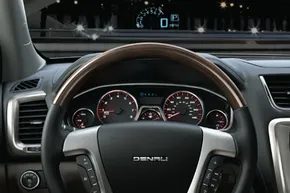
We’ve all been there. A split-second glance down at a GPS screen. A missed turn. Or worse, driving with one eye on the dash and the other on the foggy highway. It’s a dangerous compromise that head-up display (HUD) technology is finally putting to rest.
The concept is simple but revolutionary: project critical data directly onto your windshield so you never have to look away from the road to know where you’re going.
The Origins of the Heads-Up Display
You might think this sci-fi element is brand new. It’s not. The roots of the heads-up display go back to the 1950s and the cockpits of fighter jets. Pilots needed altitude, speed, and targeting data without taking their eyes off the horizon. The military figured out how to project this info onto the canopy glass. Now, that same logic is being applied to four-wheeled vehicles.
Think of your windshield not as a barrier, but as a transparent monitor. Instead of breaking your focus to check a cluster of gauges or a mounted smartphone, the HUD places your speed, navigation arrows, and lane departure warnings at eye level. You see the road and the data simultaneously.
How the Tech Actually Works
The mechanics behind the projection vary by manufacturer and vehicle tier.
- Phosphor-based systems: Some setups use a laser to shine light onto transparent phosphors embedded in the glass. When the laser hits, the information appears. Turn the laser off, and the display vanishes.
- Mirror-reflection systems: Others use a combination of projectors and mirrors to bounce an image onto the windshield. This is the more common approach in modern sedans and trucks.
The goal is the same for both methods: eliminate the need to shift your focal point from infinity (the road) to a few feet away (the dashboard).
It’s Not Just for Supercars Anymore
For years, HUDs were a luxury badge of honor, reserved for high-end German luxury sedans. If you wanted one, you paid a hefty premium. That changed significantly in 2012.
Pioneer dropped an aftermarket HUD unit that mounts to the dashboard or windshield pillar. It doesn’t require factory integration. Through Bluetooth, it connects to your smartphone app, projecting navigation prompts, points of interest, and even road hazard alerts directly onto the glass. This democratization of the tech means you don’t need a $100,000 car to benefit from reduced visual distraction.
Why We Need Heads-Up Displays
The rise of in-car entertainment and navigation has turned vehicles into rolling distractions. We’re constantly checking screens for updates, messages, or directions. This cognitive load is dangerous.
A heads-up display isn’t just a cool gadget; it’s a safety intervention designed to keep your eyes up and on the road.
By moving essential information to your peripheral vision, HUDs reduce the time your eyes spend refocusing. Less time looking away from the traffic ahead means more reaction time when things go wrong. Whether it’s avoiding a collision in thick fog or simply not missing an exit because you were fumbling with a map, the heads-up display aims to make driving safer by keeping your attention where it belongs.
The evolution of this technology is just beginning. As projection clarity improves and costs drop, the windshield will become the primary interface for everything from autonomous driving cues to real-time weather data.
It started as a gimmick. In 1988, General Motors dropped the first heads-up display (HUD) into a production car. The tech was primitive. It floated basic dashboard metrics—speed, tachometer readings—over the driver’s field of view. You could check your RPM without looking away from the road. Useful? Maybe. Revolutionary? Debatable.
Now, that old glass projector is being pushed out by something far more invasive. Augmented reality (AR).
The shift isn’t just about sharper graphics. It’s about integration. Modern AR systems don’t just sit there; they talk to everything. GPS. Infrared cameras. Mobile apps. The internet. They turn the windshield into a dynamic interface. Imagine the holographic interfaces from “Minority Report,” but stripped of the awkward hand gestures. Just data, floating in your real world.
Navigation That Doesn’t Require Glancing Down
Why does this matter? Consider the next long road trip. You’re in an unfamiliar city. The roads are a tangled mess of turns.
With a standard HUD, you might see a simple arrow. With AR, the system overlays the correct lane directly onto the asphalt. It highlights the path you need to take. No more glancing down at a small screen on the dash. No more mental calculation of where to turn. The directions are superimposed on the real world.
It gets stranger. Your mobile app can feed data to the windshield. As you drive past a gas station, the price hovers in your peripheral vision. Pass a restaurant? See the customer ratings floating above the building. Business hours? Displayed on the glass. You don’t have to stop. You don’t have to look away. The information comes to you.
Safety in the Fog
This isn’t just about convenience. It’s about survival.
We treat safety features like seat belts, ABS, and airbags as non-negotiable. But an AR-HUD paired with adaptive cruise control and onboard cameras might belong in that same category. Consider fog. It’s a killer. Visibility drops to zero. You’re driving blind.
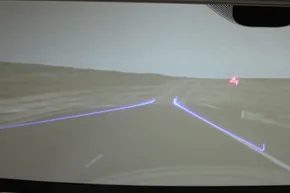
Newer HUDs use infrared cameras to detect road lines even when they’re invisible to the human eye. The system projects those lines onto the windshield. Exactly where they are in reality.
Think about that for a second. The car sees what you cannot. It projects an object that exists in the physical world but is hidden from your sight.
The same logic applies to vehicles ahead of you. If a car is obscured by rain or smoke, the HUD uses camera data and GPS to locate it. Then, it draws a digital outline on your glass. You see the car. You see the distance to it. You react faster.
Maneuvering in Real-Time
We can go further. It’s not just about seeing the car ahead. It’s about seeing how to avoid it.
Some adaptive cruise control systems already calculate escape routes during a crisis. They determine the best path to avoid a collision. But calculation is useless if the driver doesn’t understand the immediate geometry. The next evolution is projecting that solution in real-time on the windshield.
An arrow guiding you around a stalled vehicle. A highlighted path through debris. The system doesn’t just warn you; it shows you the way out.
We won’t drive blind in snowstorms or heavy rain anymore. The car becomes your eyes when yours fail. The HUD is here. Driving will never look the same.