George Mason saw a future where Nash, Hudson, Studebaker, and Packard merged into a single entity. He called it the “Big Four.” It was a desperate gamble for survival against the Big Three. Without economies of scale, the independents were dead men walking. Mason got as far as merging Nash and Hudson to form American Motors Corporation (AMC) in April 1954. He also convinced Packard’s James Nance to swallow the ailing Studebaker. That deal backfired. Packard went under. Mason died in October 1954. His dream died with him.
Enter George Romney.
Romney took the presidency. He forgot about the “Big Four.” He bet the farm on the Rambler. It was the only card left to play. The strategy worked. The 1958 recession hit hard. Competitors bled cash. Rambler sales surged. By decade’s end, AMC was profitable. The Rambler was Detroit’s best-selling compact.
The 1957 model year was a transition. These were reskinned 1956 cars. They still wore Nash and Hudson badges. New “R” hood medallions marked the change. A T-shaped grille ornament filled the space above the eggcrate grille. The real news was under the hood. AMC introduced the 250-cid V-8. It made 190 bhp. It was a derivative of the engine that would become the 1957 327-cid V-8.
Body Styles and Engine Options
The V-8 powered four body styles. All were unit-construction four-doors. They sat on the 108-inch wheelbase introduced in 1955. There were sedans. There were Cross Country station wagons. Some wagons had B-pillars. Some didn’t. This made the Rambler the first Detroit manufacturer to offer a hardtop wagon. Buyers chose between Super or Custom trim.
There was also a six-cylinder line. It kept the 195.6-cid engine from the Nash era. But it was tweaked. Output jumped from 120 bhp to 125 or 135 bhp. A DeLuxe sedan was the price leader. It cost $1961. Other Ramblers sold in the low-to-mid $2000s range.
These were small cars. They were solid. They were reliable. Optional two-tone paint made them stylish. Exterior “continental” spare tires were available on sedans. Wagons featured a roll-down tailgate window. It was better than the clumsy liftgates Ford and GM used. Roy D. Chapin, Jr., who would later chair AMC, recalled: “We just rolled with those cars. We couldn’t get enough.”
Of the 119,000 cars AMC built in calendar 1957, 111,184 were Ramblers. The rest were Nashes and Hudsons. They wouldn’t return in 1958. Not as they had been.
The Rebel Performance Machine
Romney hated Detroit’s “gas-guzzling dinosaurs.” He preached small-is-better. So it was surprising that AMC built a performance Rambler for 1957. It was called the Rebel. It was a special Custom Country Club four-door hardtop. It arrived midyear. It featured anodized aluminum flashes on the flanks.
The Rebel carried the 327-cid V-8. It made 255 bhp. It was the same engine in the final Nashes and Hudsons. But the Rebel was lighter. It was much quicker. The extra power demanded better handling. AMC added stiff Gabriel shocks. It included a front antiroll bar. Heavy-duty springs. Power steering. Power brakes.
Performance was impressive. A test at Daytona Beach recorded 0-60 mph in just over seven seconds. 50-80 mph took barely more time. It might have been faster with Bendix mechanical fuel injection. That option never made it to production.
The Rebel drank premium fuel. With 9.75:1 compression, it guzzled gas. It didn’t fit the economy image. It cost $2786. That was the most expensive 1957 Rambler. Production was limited to 1500 units. Likely because of the price.
The 1958 American and the Import Threat
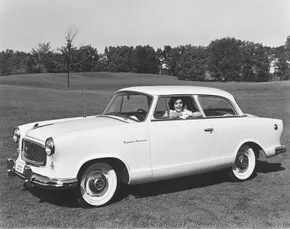
Economy imports were climbing. Volkswagen led the charge with the Beetle. AMC noticed. For 1958, they made an unprecedented move. They revived the 100-inch-wheelbase 1955 Rambler two-door sedan. They named it the Rambler American. It got a new mesh-type grille. It had full wheel openings.
Models ranged from stripped “business” units to DeLuxe and Super trims. Prices ranged from $1775 to $1874. It was a recession year. The American couldn’t help but sell. Over 30,000 were registered.
Romney had fixed AMC’s finances. He had staked the company on compacts. But the game was changing. Imports were gaining ground. The Rebel was a niche toy. The American was a volume seller. What would happen when the recession ended? And could AMC keep up with the Japanese? The answer wasn’t in 1957. It was coming.
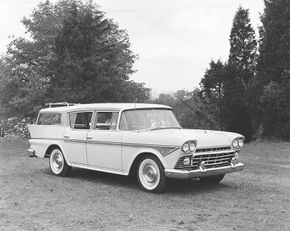
The regular Rambler didn’t get to rest on its laurels for 1958. Instead, it got a complete visual overhaul. The result? The ’56 bodies suddenly looked like they’d been stuffed into the same wheelbase, appearing bulkier by comparison. AMC added small, canted tailfins and moved the dual headlamps back out of the grille and onto the fenders. Hardtop wagons were axed from the lineup, leaving the rest of the portfolio to pivot toward volume.
Inside, AMC caught up to the times by adopting pushbuttons for the optional Borg-Warner “Flash-O-Matic” automatic transmission. It was a trendy feature, and one that signaled AMC was trying to shake off its utilitarian image. Under the hood, V-8 cars were finally rebranded as the Rebel. They kept the 250 cubic-inch engine but pushed the output up to 215 bhp. The six-cylinder engines, now rated at 127 or 138 bhp, remained nameless. They were also far more popular. No surprise there.
Enter the Ambassador
What actually caught people off guard was the introduction of the 1958 Rambler Ambassador. AMC brochures treated it like a distinct marque—”Ambassador by Rambler”—but mechanically, it was just a stretch. The standard 108-inch wheelbase got nine extra inches added ahead of the cowl. That extra space came with a standard four-barrel 327 V-8 producing 270 bhp.
The lineup included four-door sedans, Country Club hardtop sedans, and both pillared and pillarless wagons in Super and Custom trims. Visually, these Ambassadors shared nothing with their Nash predecessors. They looked exactly like regular ’58 Ramblers, just longer. The only differences were the nameplates, a finer-checkered grille, broad swathes of anodized aluminum on the Custom models, plusher interiors, and arguably better proportions.
Think of the ’58 Ambassador as what the Nash and Hudson would have been if those brands hadn’t been scrapped at the last second. In fact, the V-shaped front bumper guard on the ’58 Ambassador was taken directly from the stillborn Hudson, which had been locked in development since late 1956 alongside a nearly identical Nash proposal.
Sales That Defied the Odds
Production numbers tell a strange story. The ’58 Ambassador virtually doubled the full-size volume of the ’57 Nash/Hudson combo. Model-year production hit 14,570 units. The rarest of the bunch? Just 294 Custom Cross Country hardtop wagons. It was the only model of its kind in AMC’s entire 1958 range.
Despite the Ambassador’s modest sales, the Rambler brand as a whole had a banner year. Total sales reached 162,182, up 77 percent from 1957. That is a massive jump in an industry that was otherwise having a disastrous year. The streak of four consecutive loss years for AMC ended abruptly. The company scored a $26 million profit on $470 million in sales.
The success ended four straight years of losses for AMC, which scored a $26 million profit on sales of $470 million.
1959: The Compact Rush
That winning formula didn’t just pay off once. It netted another $60 million in profit in 1959, on Rambler volume nearing 375,000 units. A new record for the fledgling firm.
Both Ramblers and Ambassadors got more complicated body trim. A new beltline curved up gently at the rear doors, blending more smoothly with the finned fenders. Ambassadors received an even more ornate grille featuring a big “floating” horizontal bar. Powertrains remained unchanged. AMC had evidently decided the horsepower race was over. Or at least, that it wasn’t worth the marketing noise.
Unlike most competitors, AMC had evidently decided the horsepower race was over.
The compact movement was indisputably accelerating. Americans and standard Ramblers faced new competition in Studebaker’s pert ’59 Lark. Anticipating the shift, AMC expanded the American line by reviving the old two-door 100-inch-wheelbase wagon. Offered in DeLuxe and Super trim, this compact hauler helped the smallest Rambler rack up 91,000 sales.
The bigger Ramblers also performed well during 1959’s modest industry recovery. The Ambassador took a satisfying leap to 23,769 sales. Standard Ramblers attracted over a quarter-million buyers. Again, the six-cylinder models dominated. Rebel V-8s found just 16,399 customers. The market wanted economy, not power. And AMC was ready to sell it.
For more on defunct American cars, see:
-
AMC
-
Duesenberg
-
Oldsmobile
-
Plymouth
-
Studebaker
-
Tucker
1960, 1961, 1962 Rambler Cars
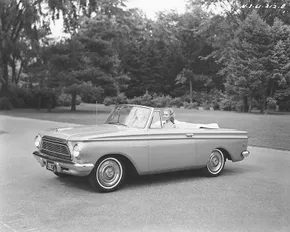
The numbers tell a story of survival that looks like success until you look at the mirror. AMC’s sales recovery from the lean years of 1954–56 was real, but the trajectory was already bending downward. By 1960, Rambler moved roughly 450,000 units. That was the peak for an independent manufacturer. It was the highest annual volume anyone outside the Big Three could touch. But independence is a lonely peak.
In 1961, production dipped 17 percent. Rambler still finished third. That sounds good until you realize the gap was closing fast. By 1962, Pontiac and Oldsmobile had surged ahead. Rambler fell to fifth. Then eighth in 1964. By 1965, ninth. By 1968, tenth. The volume was still healthy. The factory was still humming. But the market share was bleeding out.
Two leadership changes drove this slow-motion collapse. George Romney was the architect of the comeback. He left in 1962 to run for governor of Michigan. He won. But his absence left a vacuum.
The Abernethy Pivot
Roy Abernethy took over. He was energetic. He was also completely lost when it came to the core product. He saw the compact car segment as a dying breed. He wanted muscle. He wanted variety. He started expanding the model lineup with ambition but without direction.
This wasn’t just a change in taste. It was a strategic error. The Rambler brand stood for sensible economy. Abernethy treated that reputation as a constraint. He began drifting into segments where AMC had no business being. The company started chasing trends it didn’t understand.
Roy D. Chapin Jr. stepped in as board chairman in 1967, with William V. Luneberg as president. They doubled down. They diversified further. They launched the 1968 Javelin, a pony car designed to fight the Mustang. They killed the Rambler name after the last American rolled off the line in 1969. Dropping the name was probably the right call. By then, “Rambler” meant cheap and outdated. It was a liability. The sensible image was holding the company back, not saving it.
The 1960 American and the Billion-Dollar Milestone
The compact American returned in 1960 with barely a scratch. The styling was stuck in the ’50s. The Farina design was aging. The L-head six-cylinder engine was ancient. Yet it sold 120,600 units, helping the brand hit 450,000 total sales. Prices sat between $1,781 and $2,235. It was still one of the cheapest cars in America.
But bigger cars got the real makeover. The 1960 Ramblers, including the Ambassador, got smoother lines. The vertical A-pillars were gone, replaced by sloped-back glass. The fins were shapelier but still mercifully modest. Grilles varied by model—fine-checked on the Ambassador, eggcrate on the Six/Rebel. Taillights were new.
The Ambassador added a “Scena-Ramic” windshield, curved at the top and sides. A three-seat wagon with a left-hinged swing-out tailgate joined the lineup. These weren’t just cosmetic tweaks. They were calculated moves. AMC crossed the billion-dollar net sales mark for the first time. Profit hit $48 million.
The Oddball 1961 American
The 1961 American was a mess. Designer Edmund A. Anderson, a Nash veteran, went too far. The result was boxy. Truncated. The car was three inches narrower and 5.2 inches shorter than the previous generation. It looked like a mistake.
At least the engine got an update. The old L-head six received an overhead-valve cylinder head in mid-1960. Boosted output reached 127 bhp. It was a stopgap. The body styles remained confusing—sedans, convertibles, wagons, and the usual trim levels. It wasn’t beautiful. It wasn’t efficient. But it sold.
Trimming the Fat: 1962-1963
The 1962 American added posh “400” models. The “Super” trim was downgraded to “Custom.” By 1963, the naming scheme shifted to numbers: 220, 330, and 440. Hardtop coupes arrived. The 440 offered either a bench seat or bucket seats (the 440H). Styling changes were minor. The cars were economy-focused. Interior space was fair. They were ugly.
The Six/Rebel became the Classic in 1961. Headlights moved into a checkerboard grille under a lower hood. V-8s were dropped for 1962. Two-door sedans debuted. The rear fenders lost their fins. A new grille appeared. It was a clean update, but not revolutionary.
The “E-Stick” option appeared in 1962 on both the American and Classic. It was a manual transmission with an automatic clutch. Cost just $60. It was mechanically complex. Nobody bought it. It failed because it offered the worst of both worlds: manual effort without the engagement, automatic complexity without the reliability.
The Ambassador’s Identity Crisis
The Ambassador struggled to find its place. The 1961 model got a dubious facelift. Pointy front-fender bottoms. Heavily hooded headlamps. A raked, inverted-trapezoid grille. Hardtop sedans and wagons were cut. Sales slumped to 18,842 units.
The 1962 Ambassador recovered, selling 36,171 units. It dropped back to the 108-inch wheelbase used by the Classic. Styling became nearly identical. It was demoted in the hierarchy. The base engine was a two-barrel 327 V-8 making 250 bhp. The 270-bhp version was optional. Trim levels were DeLuxe, Custom, and the top-shelf “400,” which included an automatic transmission. Prices ranged from $2,300 to $3,000.
The car was competent. It was affordable. It was also invisible. By sharing too much with the Classic, the Ambassador lost its distinctiveness. It became a slightly nicer Classic. Consumers don’t buy “nicer.” They buy identity. Rambler was losing its.
The 1963 and 1964 Shift
The early 60s were about holding the line. The late 60s would be about trying to reinvent the wheel. But by 1963, the foundation was already cracking. The management wanted to be everything to everyone. They forgot that being everything to everyone means being nothing to no one.
The Rambler name died in 1969. It didn’t die because the cars were bad. It died because the company lost its soul. They chased pony cars and pony profits while the compact segment moved on. The billion-dollar profit in 1960 felt like a victory. It was just a high-water mark before the tide went out.
What happens when you realize the formula that built your company is the exact reason it will kill it? You double down. You hope the market changes before you do.
Unisides and the 1963 Classic Shift
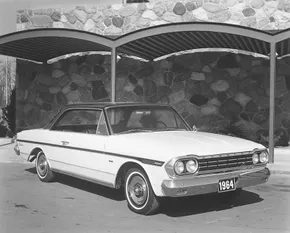
Richard A. Teague had already infiltrated the AMC styling ranks by the time Ed Anderson’s reign ended, but Anderson got the glory for the 1963 Motor Trend Car of the Year. That award-winning machine rested on a fresh 112-inch unibody platform. It was the first time AMC had introduced a new body shell since 1956. The profile dropped lower. The flanks smoothed out. Door glass curved to match the new contours.
Detroit hadn’t seen one-piece Uniside door frames before this. It was a structural innovation that cut weight, boosted chassis rigidity, and killed those annoying cabin squeaks. The look was still a bit chunky, sure, but it was a massive upgrade for Ramblers.
Under the hood, AMC swapped in a detuned 287-cid V-8. This was essentially a bored-down version of the famous 327. Output sat at a modest 198 bhp. It stayed in the lineup through 1966. The math worked out well. You got decent acceleration with 0-60 mph times around 10 seconds, even with the heavy Flash-O-Matic automatic. Fuel economy held steady at 16-20 mpg. The trade-off was physics. The V-8s added significant weight, making understeer a pronounced characteristic in corners.
Teague Takes the Wheel
Once Anderson departed, Teague refined the 1963 Classic for the 1964 model year. He swapped the concave grille for a flat one. Stainless steel rocker moldings got added. The hardtop body style returned, but this time it was strictly a two-door configuration.
Trim levels got a numeric overhaul. The old Deluxe, Custom, and 400 badges were gone. In their place came the 550, 660, and 770. These designations applied to two- and four-door sedans, as well as pillared four-door wagons.
The hardtop range split into two distinct flavors. There was the bench-seat 770. Then there was the bucket-seat Typhoon. The Typhoon was more than just a trim package; it introduced the new short-stroke 232-cid “Typhoon” six. Later renamed Torque Command, this engine began replacing the aging 195.6-cid unit across the AMC lineup. It started with 145 bhp.
For 1965, AMC offered a destroked 199-cid version of that six, making 128 bhp for the base 550 models. The Typhoon itself remained a year-only limited run. Only 2,520 were built. It came with a black vinyl roof, Solar Yellow paint, and an all-vinyl sport interior. The sticker price? $2,509.
The Ambassador’s Identity Crisis
A new Classic usually meant a new Ambassador, but the 1963 model told a different story. It shared the Classic’s wheelbase and general styling cues, separated only by extra chrome trim. The series names shifted to 800, 880, and 990. Each kept the previous three body styles.
The 800 series struggled. It vanished after 1963. The 880 followed suit, leaving the 990 as the sole survivor. The 990 offered a four-door sedan, a wagon, and a new hardtop coupe with styling adjustments borrowed from the Classic. AMC also listed the sporty 990H. This bucket-seat hardtop came standard with a 270-bhp 327 V-8.
Teague’s American Redemption
Teague officially succeeded Anderson as design chief, but ironically, his claim to fame was the 1964 American. It wasn’t a clean sheet design. It was a clever adaptation of Anderson’s Classic. Teague shortened the Unisides ahead of the cowl, resulting in a 106-inch wheelbase. That was still half a foot longer than the previous American, but it allowed for much better proportions. He kept the brightwork minimal. The result was a compact that looked good enough to survive with only minor tweaks through 1969.
The 1964 American line mirrored 1963, then thinned out by 1966. The bucket-seat 440H was rebranded as the Rogue. A convertible Rogue showed up for 1967, only to disappear for 1968. That year left a sparse lineup: just a Rogue, two base-trim sedans, and the 440 available as a four-door sedan or wagon.
Sixes still dominated sales. New-generation 199- and 232-cid engines delivered 128 and 145 bhp respectively by 1967. But 1967 also brought American’s first V-8 options. AMC introduced a new 290-cid small-block, derived from the 287 design. It came in 200- and 225-bhp tunes. V-8s remained an option until the Rambler marque folded. Prices for the American still hovered just under the $2,000 psychological barrier until the very end.
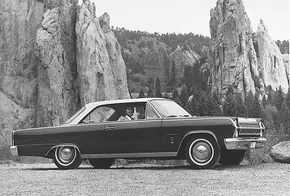
The “Sensible Spectacular” slogan didn’t quite land for everyone in 1965. It was a marketing gloss over a divided brand strategy. The Rambler Classic got a significant refresh. New convex “dumbbell” grille. Recontoured hood. A squared-off rear deck that stretched the silhouette just enough to feel modern. But the real shift was under the metal.
The 770 series brought back the Typhoon badge, now rebranded as the 770H. It was a performance cue in a lineup that was suddenly hungry for power. You could spec it with a 155-horsepower, 232-cid inline-six. Or go big with the Ambassador’s V-8 options: either the 327. The 770H didn’t stick around long. It morphed into the Rebel for 1966. That year brought a light facelift. New grilles. Minor trim tweaks. A “crisp line” hardtop roof that actually looked good. Wagons got a reworked rear end that improved utility without sacrificing style.
Why the Ambassador Needed Its Own Identity
Sales numbers don’t lie. The 1964 Ambassador sold as poorly as the 1963 model. AMC knew it. So for 1965, they split the difference. The premium Rambler line reverted to its own, longer 116-inch wheelbase. It separated itself from the budget-friendly Classic. The 880 and 990 models returned. The pillarless 990H was back, standard power was now the 155-bhp 232-six. Base V-8? The new 287. Optional 327s stayed.
The sheetmetal got an outer redo. Rectilinear lines. A Vee’d bilevel grille. Vertically stacked quad headlights. It looked like the Classic’s bigger, richer cousin. But the Ambassador did one thing the Classic couldn’t: it offered a convertible. The 990 ragtop arrived for ’65. Trunk space improved on non-wagon models. Passenger room didn’t. The extra wheelbase was pushed ahead of the cowl, stealing interior volume. By 1966, the Ambassador became a separate AMC “make.” It was a move born of necessity, not just branding.
The Marlin: A Design Experiment That Almost Worked
Enter the Marlin. Born from the Classic platform, it was AMC’s answer to the Ford Mustang and Plymouth Barracuda. Fastback styling. Sweeping pillarless roof. Elliptical rear side windows that kept the profile light. This design language wasn’t pulled from thin air. It was previewed on the 1964 Tarpon show car. Based on Ted Leaguel’s new American design, the Tarpon looked stunning. Leaguel suggested a showroom version.
But there was a catch. Bob Abernethy insisted on beating the rival 2+2 sports cars. His solution? A “3+3” seating arrangement. Three up front. Three in back. It sounded clever on paper. On steel, it was awkward. Molded on the Classic, the Marlin inherited its stubby hood. The proportions were ungainly. Did it hurt sales? Yes. Despite decent performance and a reasonable $3,100 base price, only 10,327 were built in 1965. It sold with diminishing success as its own “make” for two more years. A niche car before its time, perhaps. Or just a victim of bad packaging.
The Rebel Replaces the Classic
1967 marked the end of the Rambler Classic. In its place stood the Rebel. All-new midsize group. Roomier body. Chassis rode a two-inch longer wheelbase: 114 inches. Teague’s styling was contemporary. Floating rectangular grille. Squarish front fenders flowing into “hippy” rear flanks. A shapely deck with large, canted taillights. It looked like a car that belonged in the future.
Powertrains got a significant overhaul. Beyond the expected inline-sixes, Rebels offered a new “thinwall” 290-cid V-8. 200 horsepower. A bigger bore allowed for two new 343-cid engines. 235 horsepower. 280 horsepower. That’s real muscle for the era.
Other tech came standard or as options. Extra-cost front-disc power brakes. Available floorshift transmissions. Weight-saving Hotchkiss drive replaced Rambler’s old torque-tube setup. It was lighter. It was more responsive. Model choices narrowed to two sedans and one wagon in 550 trim. Midrange 770 came in sedan, wagon, and hardtop. The sporty SST convertible and hardtop rounded out the lineup. The Rebel joined Marlin and Ambassador as a separate AMC “make.”
The SC/Rambler: The Final, Frantic Hurrah
- The Rambler name was dying. AMC decided to go out with a bang. The SC/Rambler. Limited edition. Basically a Rogue hardtop carrying a massive 315-horsepower, 390-cid V-8. Working hood scoop. Four-speed manual with Hurst shifter. Heavy-duty suspension. A paint job that screamed cartoonish red, white, and blue.
Priced at $2,998. Nicknamed the “Scrambler” by everyone who mattered. It was anything but sensible. But it was a spectacular junior muscle car. Published road tests confirmed AMC’s claims. Standing quarter-miles in the low 14s at 100 mph. 0-60 in 6.3 seconds. Production hit 1,512 units. Triple the planned run. A cult classic before it even left the factory floor.
Collector Value and Convertible Scarcity
Rambler convertibles are rare. AMC’s volume was a fraction of the Big Three. Not surprising. The Ragtop American ran for seven years (1961-67). The open Classic/Rebel lasted four (1965-68). The Ambassador convertible just three (1965-67).
1965 was AMC’s most productive soft-top year.
* 3,882 Americans.
* 4,953 Classics.
* 3,499 Ambassadors.
They aren’t just historical footnotes. Stand to grow in collector esteem and dollar value as the years roll by. Interesting closed models too. The ’57 Rebel. The ’64 Typhoon. Of course, the “Scrambler.” These cars represent a brand that refused to play it safe. Even when it didn’t make sense.