


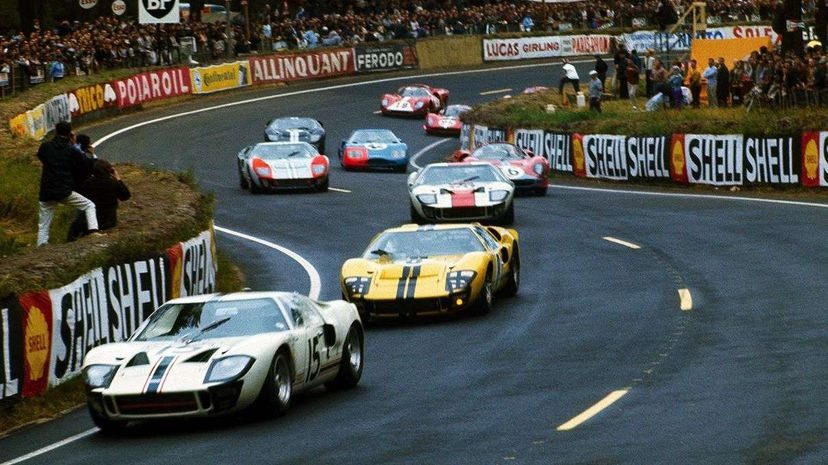
The history of car manufacturing is often described as a series of cold, logical business decisions. Corporate strategy, supply chain optimization, quarterly earnings. But sometimes it’s very personal. The development of the Ford GT40, one of history’s most iconic endurance racing cars, didn’t start on a boardroom spreadsheet. It starts with a wounded ego.
In the early 1960s, Henry Ford II saw an opportunity. The American car manufacturer wants to improve the reputation of its brand. What is the fastest way? Take an existing winner. Ford turns to Ferrari. The plan was simple: buy 90 percent of Enzo Ferrari’s company for $18 million. It will be a great success for the Blue Oval.
Then Enzo changed his mind.
The Deal That Never Was
Enzo Ferrari had no interest in becoming an affiliate. Preston Lerner recounts the moment the deal fell apart in his 2015 book, “Ford GT: How Ford Silenced Critics, Humiliated Ferrari, and Conquered Le Mans.” Enzo found a loophole in the contract. The contract requires Ford to approve all major expenditures. For Enzo, Ford Motor Co.’s “suffocating bureaucracy” was out of the question. he walked away.
Henry Ford II was not amused. The rejection hit. He reportedly gave Don Frey, the lieutenant who oversaw the failed takeover, a simple order: “Go to Le Mans and beat him.”
Beating Ferrari at the 24 Hours of Le Mans is no mean feat. This race has been held near Le Mans in France since 1923. It’s a brutal test of endurance. The cars circle the 8.4-mile (13.6 km) track. The goal is simple. The most distance in 24 hours. From the late 1950s to the mid-1960s, Ferrari was the dominated. Between 1958 and 1965, they won seven out of eight races.
Ford needed a weapon to get out of the choke hold.
Engineering the GT40
Ford chief engineer Roy Lunn came up with a solution. He didn’t want a modified sedan. He wanted a low-slung, two-seater sports car with a shark-like profile. The key innovation is the arrangement of the powertrain. The V-8 engine is located between the axles and not in front.
Dimensions are specific. The length of the vehicle is 156 inches and the height is only 40 inches. Hence the name GT40.
Development is fast. Ford teamed up with British racing car builder Eric Broadley and his company Lola. This collaboration allowed them to bypass slow internal processes that caused frustration. The result is a machine that takes full advantage of the mid-engine design.
“The Ford GT40 was one of the first sports car prototypes to take full advantage of the mid-engine design, particularly its slinky aerodynamic shape and benign handling characteristics,” explains Lerner.
This also proves something revolutionary. A big engine derived from street car design but with low internal stress can compete with some of the world’s most exotic purpose-built racing engines.
Shelby’s Intervention
Innovation alone is not enough. The GT40 struggled in its first race in 1964. It lacked the race-proven reliability required at Le Mans. Ford made an important move. They handed control to Carroll Shelby.
Shelby was a former champion driver with a personal vendetta against Enzo Ferrari. He had already beaten the Italian in an Aston Martin at Le Mans in 1959. Enzo despised him. The fit was perfect.
Shelby refined the car into a Mark II version. The 1965 Le Mans race was a disaster. Ford started strong. Later, their car was withdrawn from the race due to mechanical problems. It was a frustrating loss.
But in 1966 the bugs were fixed. The team has returned with a superior package. The GT40 Mark II didn’t just beat the Ferrari; It obliterated their dominance. Ford finished first, second and third overall.
The Controversial Finish
The 1966 race remains one of the most controversial moments in motorsport history. It is currently celebrating its 50th anniversary.
Ford executives wanted to make a statement. They wanted to show that the GT40 is the hero, not the drivers. They instructed both cars to cross the finish line at the same time. Bruce McLaren and Chris Amon were in the car. The others were Ken Miles and Denis Hulme.
But in racing, timing is everything. Miles slowed down towards the end to make sure the photo-finish was complete. McLaren, on the other hand, pushed harder. His car covered slightly more distance. The judges awarded the victory to McLaren and Amon. Miles had nothing but controversy.
Legacy of Rivalry
Ford didn’t stop there. In 1967 they returned with the Mark IV. Again, this car is designed, engineered and built entirely in the USA. They won again.
The impact of these victories extends far beyond the podium. Lerner explains the GT40 established the physical template for Le Mans racing for decades. But its cultural impact was perhaps greater.
“This is the first time a mainstream manufacturer has taken a major initiative on the international stage,” Lerner explains.
Ford changed the playbook. Instead of building and operating their own factory team, they provide funding and R&D resources and outsource the actual racing to pro teams like Shelby American. The OEM-funded and independently implemented design remains the standard in F1, NASCAR and Le Mans to this day.
The rivalry between Ford and Ferrari defined an era. It turns commercial disputes into technological arms races. Half a century later, America’s automotive legacy remains the benchmark for what American engineering can achieve under pressure.
The GT40 driven by Steve McQueen in the 1971 racing movie “Le Mans” sold for $11 million at auction in 2012. This is more than just a car. It is a monument to outrage.


