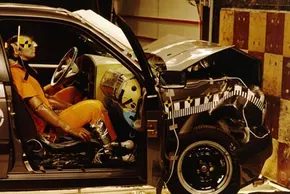
You may receive harsh criticism at work. For most people, this is a metaphor. The job of a linebacker, professional wrestler, or human crash test dummy is all about. literally.
You might think of a “crash test dummy” as a hard plastic mannequin. That’s how it used to be. Now people like Rusty Haight are entering the blast zone. Haight is a living person who survived more than 700 crashes. He does not wear a helmet for the tests. Why? Weight. Helmets add mass to the head. The extra mass increases the pressure on the neck during impact. More stress means a higher risk of injury. He sacrificed appearances to ensure that the spine’s safety record remained clean.
Crash testing is not just engineering flair. It is the backbone of automotive design, consumer protection and law enforcement. Several groups can run these tests to answer the pressing question: “How do we keep drivers alive?”
Advocacy groups such as Consumer Reports and the Insurance Institute for Highway Safety (IIHS) conduct independent safety inspections. Their goal is simple. Protect the buyer. The US government conducts its own tests. They ensure that cars sold in the country meet federal safety standards. Car manufacturers also conduct tests. They want to see if their particular design works.
All these groups use the same crude methods. they destroyed the car. They look for safety issues. They test solutions. The goal is always the same. Reduce injuries. Reduce deaths.
These tests have been an important source of information for decades. We now understand the extreme forces that act on the human body during high impact shocks. We know how the body fails. This knowledge drives engineering advancements.
Engineering Dummies
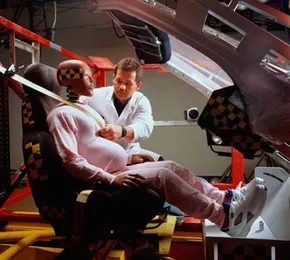

Crash testing is not just about whether the metal crumples correctly. The real goal is data. More specifically, data on how the human body reacts when metal stops moving at 60 miles per hour. It was clear to everyone that people get thrown around in a wreck. Physics is brutal and obvious. But crash tests go much deeper. It measures the exact impact forces on passengers in a controlled and measurable environment. Engineers use this precision to build better airbags, stronger seat belts and smarter safety systems.
Synthetic human anatomy
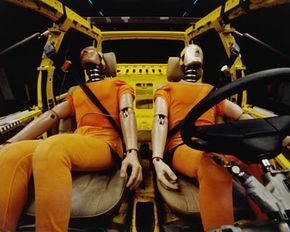
The most detailed data comes from the dummies themselves. These are not toy store mannequins. These are biomechanical replicas designed to mimic human physiology. All joints, bone density and tissue layers closely match actual human limits.
Inside these shells are sensors everywhere. They record the magnitude and direction of the forces acting on each part of the body. Engineers can see exactly where the stress is concentrated. Is the femur under too much stress? Is the neck twisted out of its range of motion? The dummies tell you.
But one size does not fit all. The size and shape of the test subjects vary greatly. There are dummies for small women, big men and children. There are also different body mass indices such as overweight, underweight, tall and short. This diversity is important because crash dynamics vary with mass and shape. Scientists also created pregnancy dummies. Its purpose was specific. to study how crashes affect pregnant women and their fetuses. It’s a grim necessity for comprehensive safety standards.
However, even this advanced synthetic human has its limits. They can’t capture all the nuances of pain, shock and physiological reactions. This gap is why some people choose to strap themselves into the driver’s seat. Read on to find out how and why they do this.
The Human Element in crash testing
Pop culture remembers Vince and Larry. These animated fiberglass dummies ran PSAs in the 1980s, urging drivers to fasten their seat belts. They were effective marketing. But the pioneers of human crash testing were Rusty Haight and Lawrence Patrick.
Haight is a former police officer. He volunteers to participate in these tests to help law enforcement better understand the crash dynamics. By understanding how the body moves during the crash, he can reconstruct the scene more accurately. He can determine not only what happened after the accident, but also what happened before the accident.
Patrick is a professor who specializes in the human impact survival research. His expertise lies in how the body withstand extreme deceleration. Both have participated in hundreds of tests. These are not just props. They are active researchers who gather data that cannot be reproduced by a machine.
###
So why take the risk? Why not rely on sensors in the plastic?
Because dummies doesn’t flinch. It doesn’t tense its muscles before the impact. It doesn’t hold its breath. You won’t experience the psychological shock of an imminent collision. Human reactions are complex. The way you support yourself affects the strength of your organs. The doll is passive. A human is reactive.
There’s also the question of comfort. Or rather, it’s missing. It’s no fun riding a reel that hits the wall. It’s violent. But for Haight and Patrick, this irritation is a feature, not a bug. Their body feedback fills in the gaps in sensor data. They talk about their feelings.

Why human data is better than synthetic sensors
Crash test dummies are technological marvels. It contains enough sensors to accurately measure G-forces, point of impact and structural deformations. It tells you exactly how much force is applied to your body. They lack biological reality. We don’t know how much force the human body can actually take before it breaks down. Without data on living humans and their remains, engineers cannot determine criteria for what is “safe” and what is “lethal.”
Dummies are static. They are passive. When a collision is imminent, people instinctively tense their muscles. This reflexive bracing changes the way energy is distributed through the body and spine. A dummy just takes the hit. It doesn’t prepare. This lack of response is a blind spot in synthetic testing.
Then there’s the skin. Dummies are covered with a synthetic material that mimics flesh, but behaves differently than flesh. Most injuries caused by accidents are not broken bones. They are lacerations. Abrasions. Tearing. The outer layer of the doll does not wear, burn or tear like human epidermis.
This is the morbid history of car safety. Before the high-tech anthropomorphic dolls we see today, there was something else. Cadavers.
The Ethical Weight of Cadaver Testing
Long before the first plastic dummy rolled off the assembly line, cadavers were used in crash tests. It may not be popular. Currently, most car manufacturers and research institutes are silent about this history. They prefer to talk about live volunteers.
However, the use of donated bodies went beyond dolls. It goes on quietly. In May 2008, a Swedish newspaper reported that Saab had used donated cadavers in 10 crash tests. Saab did not confirm or deny the report. There was an immediate backlash. The thought of mixing embalming fluid with the smell of a new car is understandably disturbing.
“Nothing kills the smell of a new car like the reality of a safety research.”
The use of cadavers eliminates some information gaps. A rigid body mimics the tense human body better than loose synthetic joints. But this creates serious moral problems. Consent is difficult to verify when the subject is deceased. Does the family really understand the nature of the test? Or has the pursuit of safer vehicles overshadowed the dignity of the dead?
Living Volunteers: High Risk, High Reward
A living human crash test dummy will sound an alarm raise alarms. These are volunteers. They sign up for slow-speed collisions to produce valuable information that cannot be copied by machines.
The data is good. Real people react to shock. they breathe. They flinch. They tense. This gives engineers a complete understanding of how people react to stress. But the price is high.
Repeated collisions, even at low speeds, can cause physical injuries. The body remembers this effect. The adrenaline runs out. The pain begins. What about the risks? This is true. Even if all possible safety measures are taken in a controlled environment, the possibility of serious injury or death still exists. The pursuit of information can overshadow the need for safety. This is a gamble with human life that few choose, but some do.
It makes me think about my daily commute. It’s easy to laugh at hitting the brakes to avoid a squirrel or scratching the mirror in a tight parking lot. The fender is only dented.
For a living crash test dummy, it’s not just a dented fender. This is part of the job.
For engineers looking at data streams, this is the difference between a vehicle surviving a crash. Technology is improving all the time. The dummies are more advanced. But the human element of fear, reflexes and vulnerability is still the most important variable in the equation.
There are still unanswered questions. How does fatigue affect crash response? How does mental state affect physical injury? The answer is there. You just have to be willing to look for it in the wreckage.