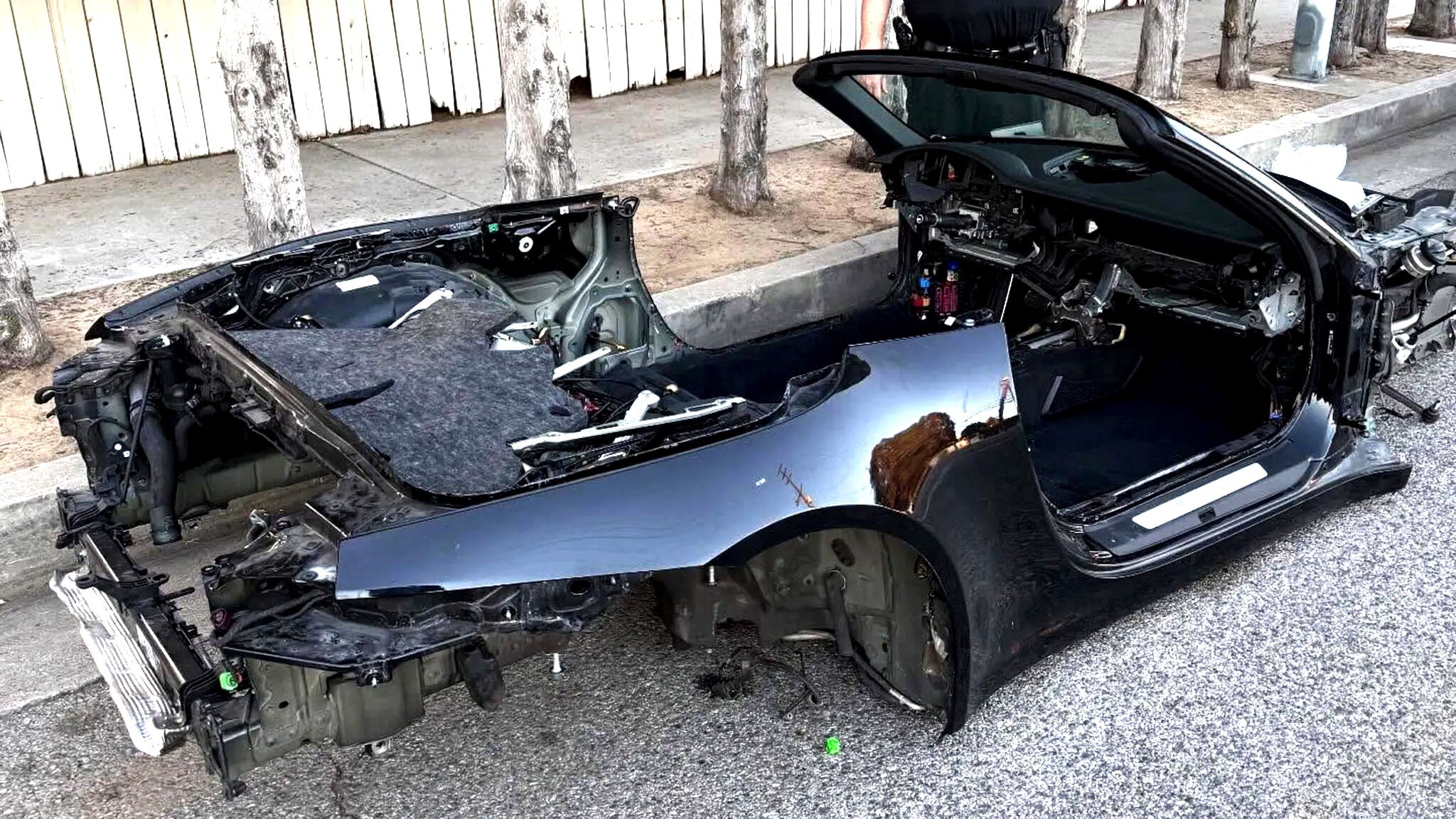
In a city like Los Angeles, where vehicle theft is a persistent reality, a recent crime has caught the attention of both law enforcement and the automotive community. This wasn’t just a simple theft of a high-end vehicle; it was a surgical, methodical dismantling that left a Porsche 911 Carrera Cabriolet looking more like a discarded scrap heap than a luxury sports car.
A Crime of Precision
When Los Angeles police discovered the remains of the black 911, the vehicle was nearly unrecognizable. Unlike typical thefts where a car is driven away to be sold or hidden, these perpetrators opted for a “parts harvesting” strategy. They didn’t just take the car; they took almost everything that made it function.
The scale of the stripping is staggering. The thieves removed:
– The Powertrain: The flat-six engine and the PDK transmission are gone.
– The Running Gear: The wheels and the entire suspension system were extracted.
– The Exterior: The hood, bumpers, fenders, doors, retractable roof, and all lighting units were stripped away.
– The Interior: The dashboard, steering wheel, infotainment system, instrument cluster, seats, and even the airbags were removed.
The precision required to strip a vehicle to this extent suggests a highly organized operation. This wasn’t a crime of opportunity by a passerby; it required significant time, specialized tools, and a location where such intensive work could be performed without immediate detection.
The “Mazda” Illusion
The theft was so thorough that it initially confused onlookers online. Due to the lack of recognizable body panels, some observers mistook the skeletal remains for a stripped-down Mazda MX-5 or even a kit car. It was only upon closer inspection—noticing the specific pedal assembly and the distinct shape of the rear decklid—that experts identified the shell as a 992-generation Porsche 911.
Why Thieves Leave the Shell Behind
This case highlights a growing trend in high-end vehicle crime: the shift from stealing whole cars to stealing components.
In the black market, individual high-demand parts—such as engines, transmissions, and electronics—can often be sold for a higher cumulative profit than the car itself. By leaving the chassis behind, thieves avoid the most difficult part of the crime: dealing with the Vehicle Identification Number (VIN). The VIN-stamped chassis is the “fingerprint” of the car; it is easily traceable by police and impossible to hide. By abandoning the shell, the thieves effectively sever the connection between the stolen parts and the original identity of the vehicle.
The Economic Aftermath
While the chassis remains structurally intact, the vehicle is effectively a total loss. The cost of sourcing and reinstalling every missing component—from the engine to the wiring harnesses—would far exceed the market value of a standard Carrera trim.
For the owner, the car has transitioned from a high-performance machine to a piece of salvage. The investigation is now in the hands of detectives, who are working to trace the theft’s origin and determine how such an intensive dismantling operation was carried out undetected.
This incident serves as a stark reminder that for high-end vehicle owners, even advanced security measures like GPS tracking may not prevent a loss if the thieves are more interested in the parts than the car itself.
The meticulous stripping of this Porsche illustrates a sophisticated criminal tactic where individual components are prioritized over the vehicle as a whole, rendering the car a total economic loss while leaving the traceable chassis behind.