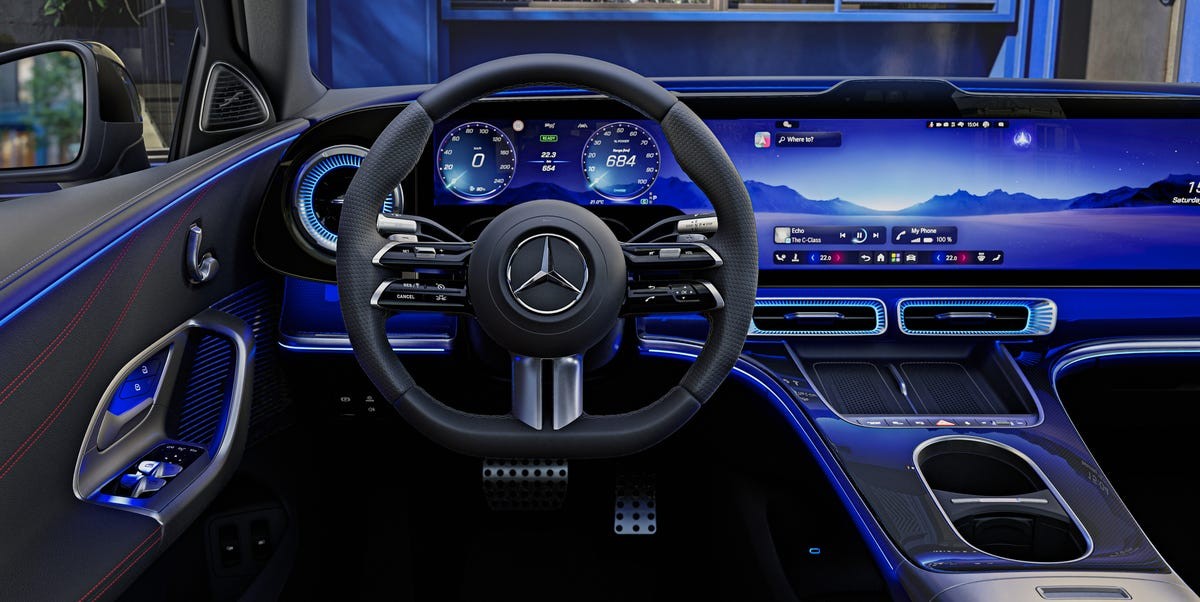
Mercedes-Benz has provided a preliminary look at the cabin of its upcoming C-Class EV, offering a glimpse into the brand’s digital-first strategy before the vehicle’s full reveal on April 20.
As the automotive industry shifts toward electrification, Mercedes is positioning this new electric sedan as a direct competitor to premium electric models like the BMW i3. The preview highlights a cabin defined by massive digital interfaces, sustainable luxury, and advanced sensory technology.
A Digital-First Cockpit: Superscreen vs. Hyperscreen
Continuing its trend of “glitzy” digital integration, the C-Class EV centers its design around expansive displays. Mercedes is offering two distinct levels of digital immersion:
- The Superscreen: The standard configuration featuring prominent digital displays across the dashboard.
- The Hyperscreen: An optional, premium upgrade where the displays are seamlessly connected into a single, continuous glass surface.
To enhance the user experience, Mercedes is offering 10 distinct color schemes that synchronize the digital interface with the vehicle’s ambient lighting, allowing drivers to customize the cabin’s atmosphere.
Luxury Through Sustainability and Sensory Detail
The interior design reflects a broader industry trend toward “conscious luxury.” Mercedes is moving away from traditional leather-heavy interiors in favor of more sustainable options:
- Vegan Certification: Following the GLC-Class EV, the C-Class EV will offer upholstery certified by the Vegan Society, catering to environmentally conscious luxury buyers.
- Material Variety: Despite the vegan options, the cabin remains highly customizable with finishes including Beech Brown, Macchiato Beige, and various open-pore wood trims (birch or natural fiber).
- Atmospheric Features: An optional “Sky Control” panoramic roof features 162 tiny illuminated stars embedded in the glass, aiming to create what the company calls a “crafted sanctuary.”
Advanced Comfort and Acoustic Engineering
Because electric vehicles (EVs) lack the natural masking noise of an internal combustion engine, Mercedes has focused heavily on NVH (Noise, Vibration, and Harshness) reduction. The C-Class EV utilizes sound-deadening materials, aerodynamic shaping, and noise-insulating glass to ensure a quiet cabin.
For passenger comfort, the vehicle introduces several high-end features:
– Ergonomic Seating: Front seats include ventilation, massage functions, and four-way lumbar support to reduce fatigue.
– Burmester 4D Audio: An optional surround-sound system that uses “exciters” integrated into the seats, allowing passengers to physically feel the music through vibrations.
– Efficient Climate Control: A new multi-source heat pump allows the climate control system to heat the cabin twice as fast as previous gas models while using roughly half the energy—a critical factor in preserving EV range.
Market Context: The Dual-Track Strategy
Notably, Mercedes does not intend to replace its gasoline-powered C-Class immediately. Instead, the C-Class EV is expected to coexist with the internal combustion engine (ICE) version for a transitional period. This allows the brand to capture both traditional luxury buyers and the rapidly growing segment of electric vehicle enthusiasts.
The C-Class EV represents Mercedes-Benz’s attempt to blend high-tech digital immersion with sustainable, sensory-driven luxury to compete in an increasingly crowded electric sedan market.
The full reveal of the Mercedes-Benz C-Class EV is scheduled for April 20.