


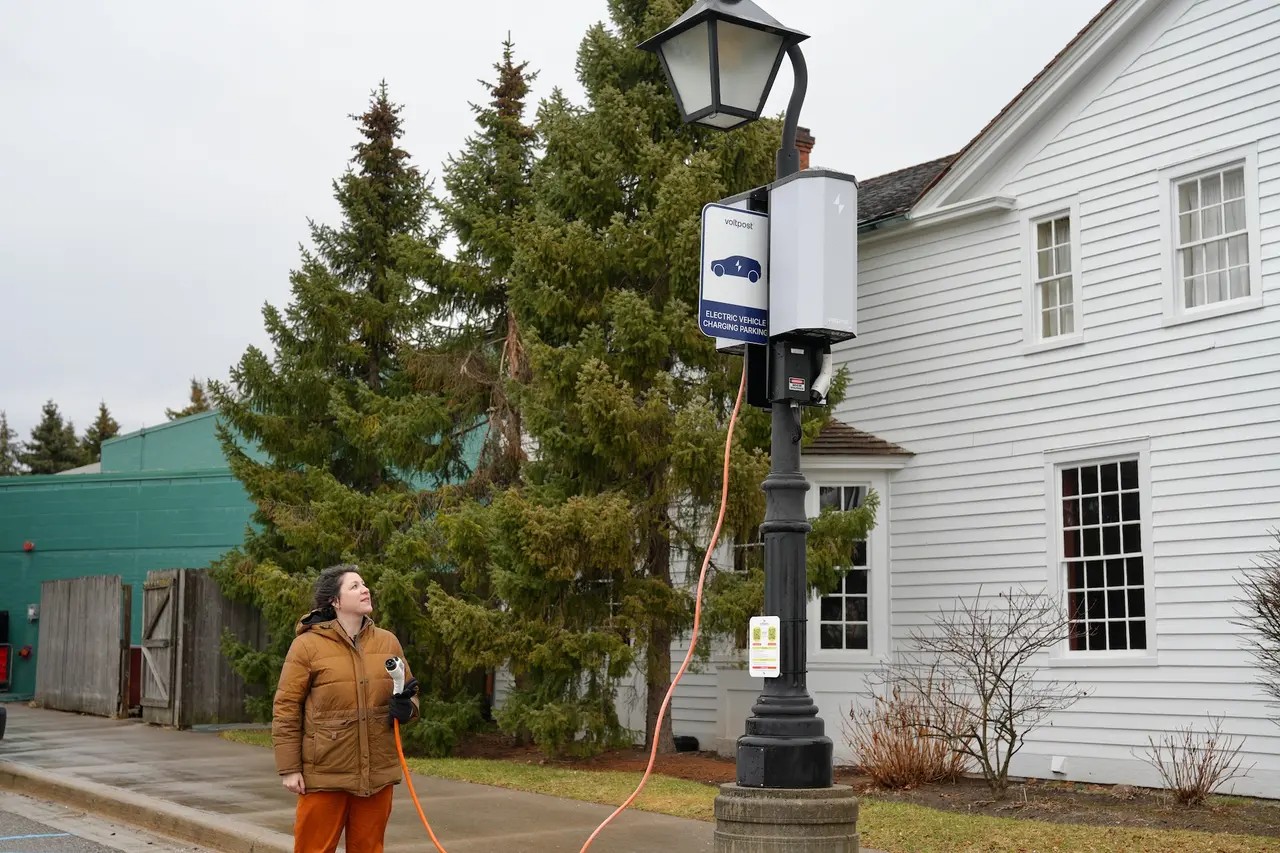
Urban EV charging is stuck in a rut. The problem isn’t interest. It’s logistics. How do you add high-voltage infrastructure to crowded streets without digging up asphalt, disrupting traffic, or cluttering sidewalks with bulky cabinets? Washington D.C. is testing a surprisingly simple answer. Turn streetlights into charging stations.
It sounds too easy to work. But for drivers who don’t have a garage, it might be the only scalable option that doesn’t require municipal surgery.
Why Streetlights?
Think about the infrastructure already in place. Streetlights line every major residential and commercial block. They are anchored. They have power. They sit exactly where cars park.
Building a traditional Level 2 or Level 3 charger requires trenching. It requires permits. It requires digging up the road to lay new conduits from the grid. That’s expensive. That’s slow. That’s disruptive.
Adapting an existing pole skips the civil engineering nightmare. You aren’t building new. You’re upgrading old.
The Voltpost Pilot
Washington D.C. is moving from theory to practice. Voltpost, a startup specializing in this exact niche, has a pilot program on the table. They plan to install up to 16 charging units directly on existing streetlight poles.
This isn’t a speculative concept. It’s a partnership with local energy and environmental stakeholders. The goal is concrete deployment.
The technology? Level 2 charging.
Why Level 2? Because it matches the behavior of curbside parkers. You aren’t stopping for five minutes. You’re parking for four, six, or eight hours overnight. A Level 2 charger delivers enough power to top off a depleted battery while you sleep. It doesn’t need the massive electrical upgrades required for DC fast charging.
“Rather than creating a complete station with its own civil engineering, trenches, and dedicated connection, the idea is to adapt existing urban furniture to add a charging function.”
The Trade-Off
There is a catch. Level 2 is slow.
If you need a charge in twenty minutes, this won’t help. But if you live in an apartment complex without dedicated spots, or you park on the street after 6 PM, slow and steady wins the race. You plug in. You wake up. You drive.
Washington is testing the waters. If these 16 units prove viable, the model could replicate across cities that are otherwise gridlocked by infrastructure costs.
The question isn’t really technical. It’s political. And logistical.
Can cities update their lighting grids to support bidirectional flow? Can they handle the load without brownouts?
Voltpost says yes. The streetlights are already there. The power is already running. All that’s missing is the connector.
We’ll see if Washington lights up first.
Forget the neon glow of Tesla’s Superchargers or the high-voltage race for Ionity’s 350kW stalls. That isn’t this story. Those networks are built for the road trip, for the 20-minute pit stop that gets you back to 80% before you grab a coffee. But for the millions of urban dwellers who live in apartments, park on the street, and lack a private driveway, that speed is irrelevant. The real friction isn’t charging fast. It’s waking up every morning with enough juice to get through the day without anxiety.
This approach solves a different problem. It’s about the daily grind, not the grand tour.
The Hidden Grid Complexity
The allure is obvious: cities already have a dense skeleton of electricity. Every streetlamp is a potential node. But swapping a lightbulb for a vehicle connector isn’t a trivial hardware swap. You can’t just plug into an existing LED circuit.
The grid capacity is usually insufficient for continuous high-draw charging. Local networks need reinforcement. Protective devices must be upgraded. Cabling requires hardening. Payment systems need integration. And crucially, you have to manage load to prevent creating new peaks in energy demand that could destabilize the local supply.
Los Angeles is already testing this. They’ve attached chargers directly to public lighting fixtures, leveraging existing underground circuits. The pitch is economic: develop curbside charging without digging up the entire street or installing massive new substations. Europe has its own players, like Ubitricity, which embeds charging points into streetlights and urban furniture, specifically targeting residential street-side replenishment.
The city already has the skeleton. The challenge is strengthening the veins.
Utility Over Spectacle
Is it as flashy as a supercharger? No. Is it more practical for the average commuter? Often, yes. A car sits parked over 90% of the time. Distributed slow charging across residential streets can cover the bulk of daily mileage without forcing drivers to plan their lives around public stations. It removes the need for the “full electric” ritual of old—filling up to the brim every night—replacing it with a trickle charge that keeps the battery topped off.
But scale is the killer. A few experimental poles are a nice PR stunt. Thousands of reliable, accessible, and well-maintained points change the game entirely. If the hardware fails, or the network is down, the promise vanishes.
The Urban Opportunity
The insight here is urban, not just technical. It’s about leveraging infrastructure that’s already in the ground to make electric vehicles less disruptive and less dependent on massive construction projects.
In France, there’s an even tighter opportunity. Imagine the parking meter and the charger becoming a single unit. Pay for the spot, and the power flows. It simplifies the user experience. One transaction. One app. One pole.
It’s not a replacement for the highway network. It’s a complement. And for the apartment dweller, it might be the only thing that makes going electric actually workable.


