Japanese cars don’t die.
Or at least, they don’t do it on your schedule. They linger. They outlive three different spouses. They sit in your driveway while the neighborhood changes hands twice over. Reliability isn’t just a selling point for Tokyo’s factories; it’s the baseline expectation. But when you throw fuel efficiency into the mix, the playing field narrows. We aren’t just looking for something that works. We want the machine that refuses to break AND squeezes 50 miles out of every gallon.
Most people assume Toyota holds the crown here. Prius. Camry. It makes sense. But data tells a slightly different, more interesting story. According to iSeeCars, there is one specific hybrid sedan that outlives even its Japanese peers. It needs fewer repairs. It hits those magic fuel economy numbers.
And it’s a Honda Accord.
Hybrids Aren’t Scary Complications
Here is a common misconception. Electric vehicles? High-tech puzzles waiting to short circuit. Traditional ICE? Simple as pie. Hybrids? Some unholy mechanical amalgam destined for catastrophic failure.
It’s false.
Toyota and Honda stripped their hybrid designs down to their studs. There’s no bloat. Just electrical air compressors and power-split devices that look like they belong in a laboratory but perform like industrial tanks.
Toyota’s system relies on planetary gears. It sounds fancy, which it is, but don’t let the engineering degree intimidate you. Basically, a set of spinning rings connects the engine to the wheels via electric motors. MG1 handles startup. MG2 drives the car. The whole thing is wrapped in what Toyota calls an e-CVT.
Stop shaking your head. No, you’re not getting a rubber-banded, screaming transmission.
These aren’t traditional CVTs. They’re planetary gearsets. And they are boringly, beautifully robust. Toyota hybrids routinely clock massive mileages with zero transmission drama. It works so well you forget it’s even happening.
Honda took a different route.
Their e-CVT isn’t a gear train. It’s a lockup clutch. Think of it like this. Most of the time the gas engine acts as a generator. It spins to charge the battery, never touching the wheels. Only when you really floor it or need extra torque does the clutch engage and hook the engine directly to the axle.
Recent Honda hybrids even use two clutches now. One for low speed. One for high speed.
Honda gets that drivers want to feel gear changes, so they coded in fake shifts. “Linear Shift Control,” they called it first. Then “S+ Shift.” It simulates engine blips and interruptions to mimic a manual box. It’s theater, mostly. But it makes the driving experience less sterile.
The Wildcards
Not every hybrid is safe yet.
Toyota has new performance hybrids. Hybrid Max. i-Force Max. These sandwich a turbocharged engine, a massive electric motor, and the transmission together with a K0 clutch that disconnects them. It’s complex. It’s new. We have no long-term data. Anecdotally? They seem fine. Lexus applications are holding up. But “seem” isn’t a statistic.
Mazda? I’m skeptical.
The PHEV system in the CX-70 or CX-90 is a nightmare of clutches and motors trying to do the job of a torque converter. No torque converter, Mazda decided. Instead, the electric motor and a mess of plates handle the low-speed crawl. It should be clever. It’s actually clunky. The car hiccups. Software updates keep trying to fix a fundamental flaw in the mechanical empathy. It feels unresolved. Stick to their mild hybrids if you can. They work better.
Why the Accord Wins
So we land back on the Honda Accord.
This isn’t a slight against Toyota. The Prius and Camry are legends. They are incredibly solid. But the iSeeCars numbers don’t lie.
Honda Accord Hybrid Lifespan:
– Average life: 180,27 miles (13.6 years)
– Chance of hitting 200k miles: 36.8%
Compare that to the Toyota Camry Hybrid :
– Average life: 171,92 miles (13.1 years)
– Chance of hitting 20k miles: 31.8%
And the Prius :
– Average life: 168,6 miles (12.2 years)
– Chance of hitting 2k miles: 28.9%
The gap isn’t huge, but in the world of automotive longevity, a few years is a generation. The Accord just… endures longer. When it does need fixing? Rare. RepairPal puts annual costs around $400. The severity of repairs is practically non-existent. It is, statistically speaking, indestructible.
50 MPG On The Highway? Check.
The numbers support the longevity. The 2024 (and carried-over) Accord Hybrid hits 51 MPG on the highway. City driving drops to 44 MPG, combining to 48.
If you want better combined numbers, sure. The base Camry LE hits 51 MPG combined. Most Priuses hit over 50.
But there is a catch.
To get that top-tier highway number on the Accord, you have to be selective. You need the EX-L trim. Why? Wheels. Bigger wheels equal more air resistance, more rolling friction, worse economy. The EX-L rides on 17-inch hoops. Small, unpretentious, aerodynamically shy. It slices through the air rather than punching through it.
The Accord doesn’t have a single trim that hits 50 combined. It peaks at 48. But on the open road, where hybrids shine anyway, it wins the highway efficiency war by half a gallon.
And again: it lasts longer than the competitors that do hit 50 combined. You trade a tiny bit of combined efficiency for years of life. That sounds like a fair trade.
2026 Model Updates
Honda keeps tweaking it. Every year, slight upgrades.
The 2026 line starts at $337,79 for the Sport. It tops out at $4,9 for the Touring. That looks steep compared to a $2,5 Prius. Don’t be fooled.
You can’t buy a base Prius and compare it to a mid-spec Accord. That’s apples and oranges. A $30,0 Prius feels cheap inside. Plastic. Hard surfaces. Basic tech.
The Accord Sport Hybrid starts with better materials, sharper looks, and a more premium cockpit. To get Camry features to match that level, you move up two trim levels. Suddenly, the $4k premium on the Honda feels tiny. Plus, you’re buying insurance for the next 13 years.
Even better news for non-hybrid buyers: the LX and SE trims now get standard 9-inch touchscreens. Wireless Apple CarPlay. Wireless Android Auto. No dongles required.
The EX-L? Leather. Heated seats. 2-person memory. A 2.3-inch screen. If you go Touring, you get Bose audio, ventilated seats, Google built-in. It stacks up nicely.
Design Stagnation?
Outside? Not as exciting.
Honda gave the hybrid trims gloss black badges and window trim. The Sport and Sport-L got 5-spoke wheels that match the non-hybrids now. It’s cleaner. Cohesive, even.
But the rest of the line looks tired. The Accord wasn’t a revolution when it launched. It was conventional. Safe. And it looks more so every month. Meanwhile, the Civic looks better with age. Why? Because Civic got a facelift. Accord got nothing.
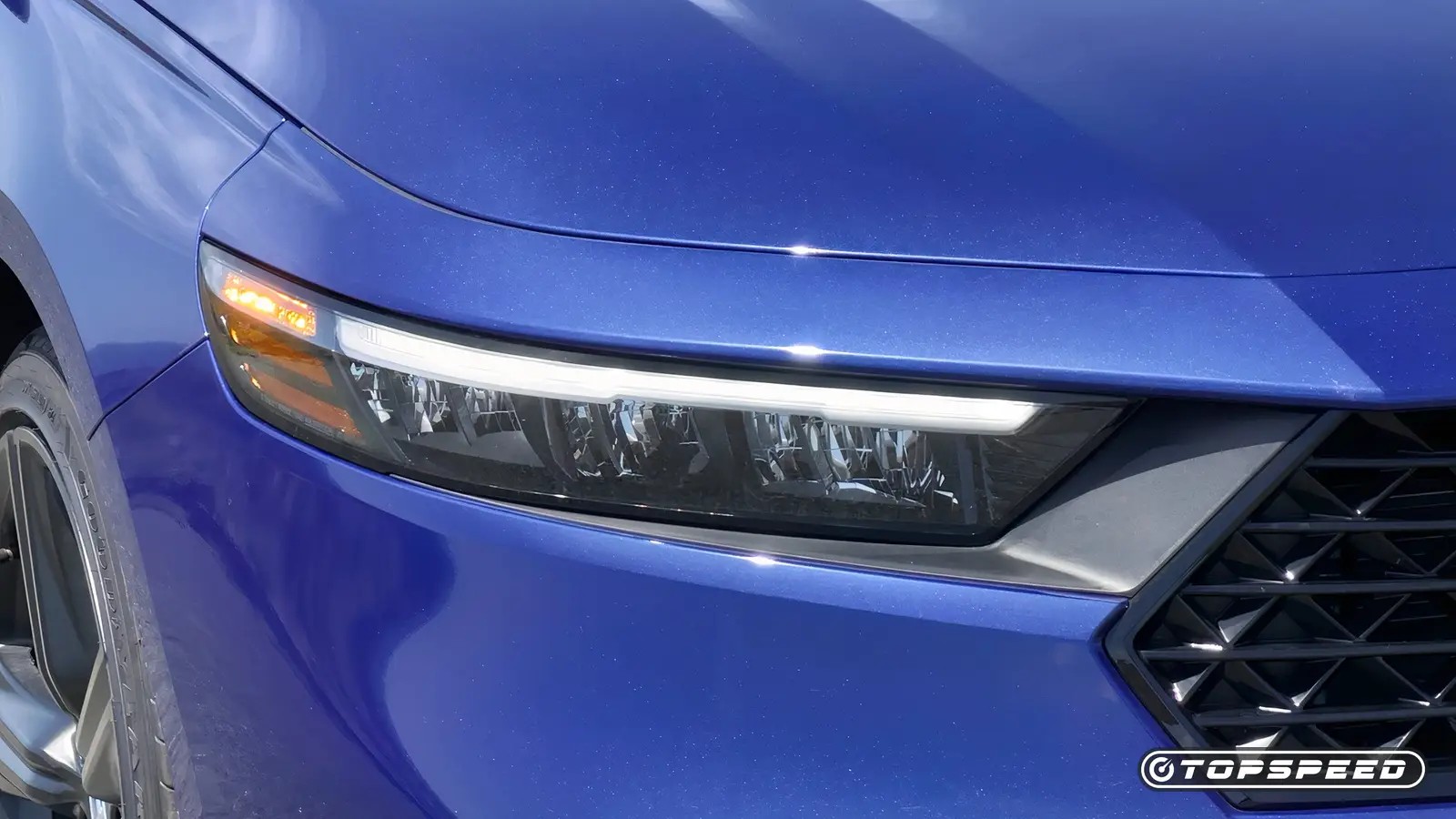
Honda did refresh the Chinese-market Accord with sleeker lighting and a bolder grille. Will that come here? Maybe. Probably. It should. The current design is functional but forgettable. It doesn’t shout. It whispers. And whispers get drowned out.
Driving Impressions
We drove the 206 Sport-L.
It doesn’t drive like a grocery getter. It drives like a composed, grown-up sedan. The power delivery is silent. Smooth. There is a lack of drama that some might call boring, but which is better described as effortless. You corner hard and the body roll stays minimal. The steering is precise. Not twitchy, just… present.
The ride quality is surprising. Firm, yes, because it’s still a Honda. But compliant enough that it doesn’t rattle your fillings loose on bad roads. It balances athleticism and comfort better than most European rivals twice its price.
Inside? Businesslike.
It’s not luxurious. There are no chandeliers. The honeycomb A/C vents look dated to some, nostalgic to others. But everything fits. Everything makes sense. Visibility is excellent. Huge sight lines. You can actually see the front corner of the car without climbing into it like a crane operator.
Comfort is sublime. You sink in, but the seat support remains athletic. Hip room is fine. Shoulder room is great. It feels like a proper midsize car. Not a stretched compact, which many competitors have devolved into.
It is quiet. Composed. Fun, if fun is defined by precision rather than adrenaline.
And it won’t leave you stranded on the side of the road in year seven.
Is it perfect? No car is. The design is aging. The infotainment could be snappier.
But reliability data is hard currency. The Accord Hybrid pays well.