Honda is the tech giant of motorcycling. Always has been. Ever since the first engine fired up, they’ve built machines that scared the rest of the industry into obsolescence. Think of the NR750. Oval pistons. A V8’s breathing habits crammed into four cylinders. A mechanical puzzle so complex it generated 200 patents on its own. Or the CB750 in the 70s. It gave the world disc brakes. Electric starts. Reliability wasn’t an accessory back then, it was the standard.
Then came the dual-clutch transmission. DCT.
DCT That Wasn’t Ready
It’s brilliant engineering, really. The first clutch stays engaged while the second pre-selects the next gear. The shift happens without torque interruption. No pause. No slip. Cars had proven it. Racing teams knew it. Honda put it on two wheels before anyone else dared to try.
But here is the rub. At the time, riders weren’t ready to let a computer shift for them. The sport-touring segment was lukewarm, mostly ignored compared to today’s boom. Honda launched anyway. Roughly fifteen years before the market trusted automation. It was a bold swing. A miss that left a gap the company hasn’t filled.
The DCT was too advanced for 2010, but it was exactly what we needed for 2020.
The Empty Chair in the Showroom
Today? The market is hungry for tech-tourers. But look at Honda’s lineup.
- There is the NT1100, running a parallel-twin from the Africa Twin. Good bike. Not the flagship.
- The CB1000GT launched globally last year. Inline-four. Proper liter-class torque. But for the American market? Radio silence. No hint of a launch date.
Why?
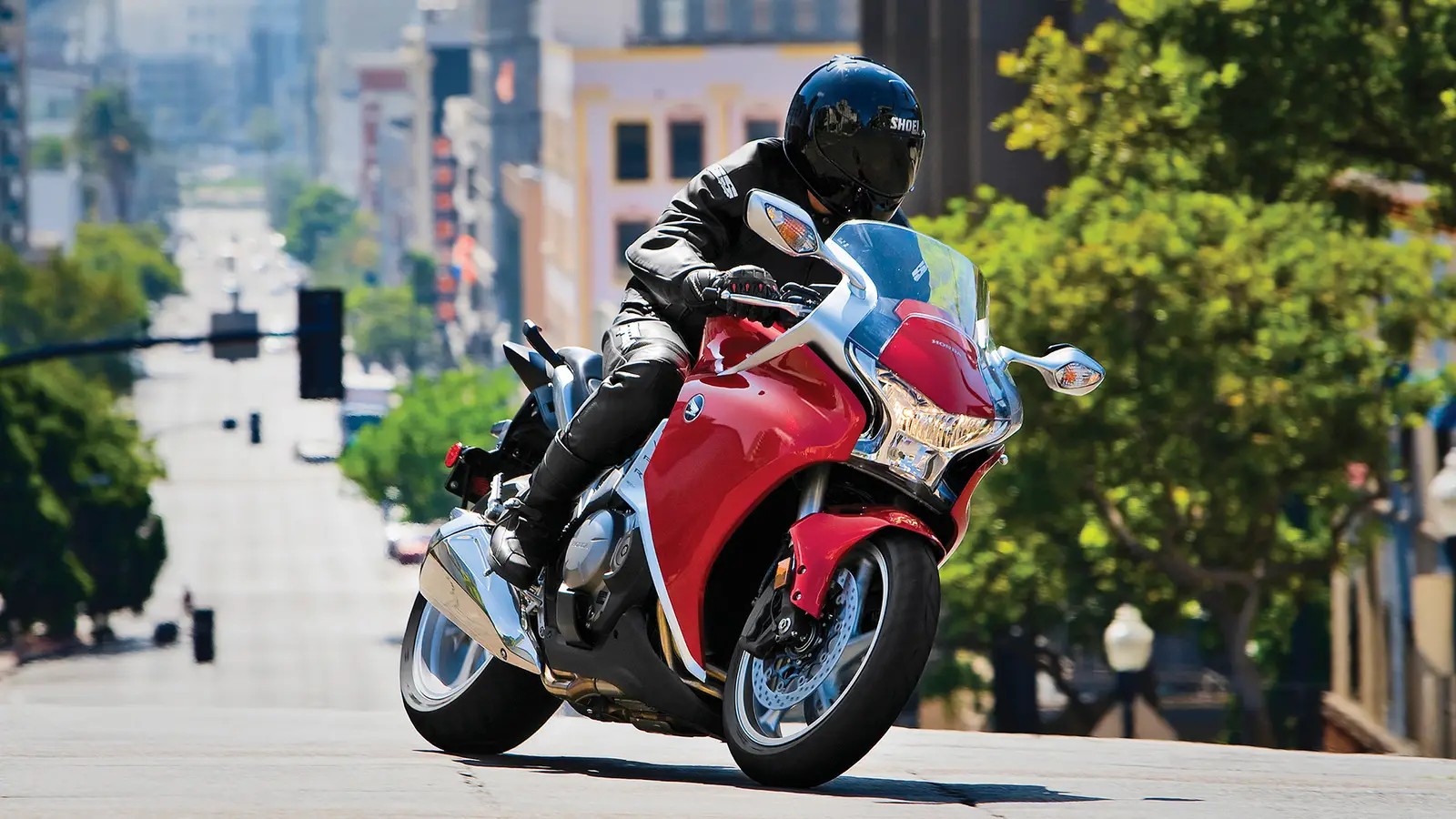
Was the VFR1200’s failure too painful to repeat? The VFR was Honda’s sport-touring king in 2010 before vanishing by 2015. Remaining units lingered in showrooms until 2016, gathering dust. It started as a concept in 2008 at InterMot. When it finally landed, it wasn’t just a refresh of the aging VFR800. It was a blank slate.
A new architecture.
The Narrow V4 Masterpiece
The engine is where Honda separated the men from the boys.
A narrow-angle V4. Single-sided shaft drive. An optional DCT box that learned your riding habits. The base MSRP sat at $15,999. Add the DCT and you were looking at $17,499. Today? You can snag a used VFR for under $6,000. Or up to $9,00 if the mileage is low. The price collapsed. Half value, double the enjoyment.
Underneath the fairing, the mechanics were obsessive. Honda paired the rod journals of the rear cylinders between the front cylinders, rather than side-by-side. This narrowed the engine block, fitting tighter between your knees. More importantly, it canceled out the rocking vibration common in standard V4 layouts.
The SOHC heads? Borrowed directly from the CRF450X motocrosser. Compact. Efficient.
The sound?
Flat. Crisp. Almost 360-degree. The 76-degree V-angle with offset crankpins created a tone no other bike possessed. 167 horsepower. 95 lb-ft of torque. 90% of that pull available by 4,000 RPM. In 2010 nothing else could match that low-end shove. Today? It still keeps up with half the sport-touring market.
Software Growing Pains
The DCT wasn’t perfect on day one.
Early reviews were harsh. The “Drive” mode downshifted aggressively, hitting sixth gear too quickly and killing throttle response. “Sport” mode held gears too long, waiting for the redline regardless of throttle position. Frustrating. Stiff.
Honda listened.
A 2012 software update changed the game. Traction control arrived. Shift logic learned the rider. By 2013 the gearbox held gears under aggression better, launched with more authority, even if the downshift clattered slightly. It got smarter. You had to let it.
The shaft drive? Equally clever. Honda refused conventional final drives. The Pro-Arm single-sided swingarm held an offset shaft with sliding CV joints. They engineered it specifically to kill the “jacking” effect inherent in shaft drives. Add the Combined ABS—pioneered on the CBRs—gripping 320mm discs, and the brakes were bulletproof.
The bodywork remains futuristic. Honda’s layer-concept fairings channel air between shells to cool the engine, keeping the rider’s legs cool. It looks just as strange and wonderful now as it did then.
Should You Buy One Used?
If you want the experience without waiting for Honda’s corporate calendar, go find a used VFR1200. J.D. Power estimates values around $7,000–$9,000, though the black market has deals for $6,000.
They are tank-like. The V4 engine is essentially indestructible. The DCT is durable. But don’t be sloppy.
- Check the recall records. A major drive-shaft issue required repair. Make sure it’s done.
- Inspect the front calipers for corrosion.
- Check for rubber O-ring leaks on valve covers.
Early models suffered short fuel ranges. Later model years fixed the mapping. Buy new, if you can afford it. Otherwise, the late-models offer the best ride quality. It will last you decades. It already has.
Who Would It Fight?
If Honda revived the VFR in 2026, the playing field looks different.
BMW dominates this space with the R 1300 RT. A 1,300CC boxer-twin producing 145 hp and 110 lb-ft. Shaft-driven. Single-sided swingarm. It tips the scales at 619 pounds wet—nearly identical to the VFR’s 614. Priced at $22,495. It’s the modern benchmark. Solid. Confident. But does it have the V4’s soul?
Then there is Kawasaki’s Ninja H2 SX SE.
This is the true arch-nemesis. A supercharged 998CC inline-four pumping out 200 hp. Backed by semi-active suspension and radar-assisted adaptive cruise control. Priced near $30,000. It does everything the VFR did, only faster. Only more expensive.
The VFR occupied a unique niche: the high-revving, exotic sound package that wasn’t just fast, it was special. The H2 owns the “fast” niche now. But who owns the engineer’s dream?
The market is ready for a computer-assisted, V4-powered, shaft-driven missile. Honda invented it. They dropped it. The technology has only matured since then. The rivals are comfortable in their seats.
Honda knows they could win. They just haven’t pulled the lever yet. Maybe they are waiting for the stars to align. Maybe they don’t remember the sound those exhausts made.