The story of Reo didn’t start in a boardroom. It started with a shouting match. In 1904, Ransom Eli Olds—founder of Olds Motor Works, the first automobile company in the United States—had a falling out with his own executives. They wanted to move away from his tiny, successful Curved-Dash Oldsmobile and build heavier, more expensive four- and six-cylinder cars. Olds refused. So he packed up and moved down the street to start a rival firm. He named it after himself: the R.E. Olds Motor Car Company. But the press dropped the “R.E.” almost immediately. It became just Reo.
Olds got his revenge in a way. Through 1917, Reo outproduced Olds Motor Works.
For its first fifteen years, Reo built everything from one-cylinder runabouts to six-cylinder touring cars. The company hit its production peak in 1928, rolling out 29,000 vehicles. By then, they had abandoned the smaller engines. They were selling sixes only. Then the stock market crashed. In 1929, car sales plummeted by nearly 30 percent. Reo took a massive $2 million loss on roughly 12,500 cars and trucks in 1930. The Great Depression didn’t just hurt Reo; it broke its spine.
After 1932, Reo never sold more than 5,000 cars a year. But if you look at the salvage, something interesting emerges. The cars Reo managed to build in those dark years were among the most elegant automobiles ever designed. They were handsome. They were solid. They were also completely irrelevant to the market that had vanished.
The Last Gasp of the Flying Cloud
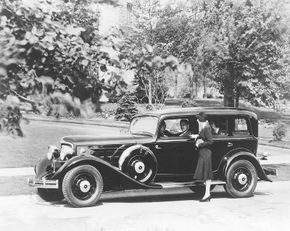
The 1930 Flying Cloud Sixes were barely different from the 1929 models. The junior Reo was the Model 15, sitting on an 115-inch wheelbase. It used the same 60-horsepower, 214.7-cubic-inch Continental engine that had powered the low-priced Flying Cloud Mate the year before. The senior models were the Flying Cloud Masters: the 120-inch Model 20 and the 124-inch Model 25. These carried a 268.3-cubic-inch Reo engine pushing 80 horsepower.
Prices had dropped from pre-Depression levels to an upper-middle bracket of $1,175 to $1,870. Styling was the work of Amos Northup, a designer who was talented but largely unappreciated at the time. His work was classic, formal, and perfectly proportioned. The fit and finish were top-notch. The furnishings were luxurious. It was a car built for a different world.
The Big Eight Gamble
January 1931 brought an expanded lineup. Reo was desperate to climb back up the sales charts, so they introduced two new straight-eight engines. The naming convention was rigid: the first number indicated cylinders, the second was the wheelbase.
The biggest engine was a 358-cubic-inch unit producing 125 horsepower. It was reserved for the new 8-35 Royale, a car sitting on a robust double-drop frame with a 135-inch wheelbase. This same engine powered the companion 8-30 Flying Cloud. At the bottom of the eight-cylinder ladder sat the new 6-25, using an 85-horsepower 268-cubic-inch six, priced around $1,800.
The Royale was the star, premiering at $2,495. It came with three closed bodies built by Murray. They were smooth. Truly beautiful. Northup was leading the industry with skirted fenders, rounded corners, and raked-back radiators. The 8-30 and 6-25 wore a more conservative version of this sleek look.
Reo also announced a monstrous 152-inch chassis for the Royale, intended for custom coachwork by Dietrich. This would have produced a seven-passenger limousine and three convertibles. These were opulent machines. Show models, mostly. Few were actually built. The big nine-main-bearing engines offered effortless performance, sure. But were they appropriate for hard economic times? No.
Burning Cash on Elegance
Reo spent $6 million developing these 1931 models. They hoped the style alone would spark sales. It didn’t. The market wasn’t ready for $2,500 luxury cars when people were worried about their next meal.
Reo threw more variations at the wall. They released the Royale 8-31. They introduced the Flying Cloud 8-25, which featured a new 90-horsepower eight that wasn’t much larger than their six-cylinder engine. They dropped the price of the 6-21 to between $995 and $1,100. None of it mattered. Reo lost nearly $3 million on sales of just 6,762 cars.
They tried again in January 1932 with a smaller Flying Cloud. The 6-S sat on a 117-inch wheelbase and used a debored 230-cubic-inch six making 80 horsepower. It was the entry-level line, available in nine open and closed models with Standard and DeLuxe trim. Prices ranged from $995 to $1,205. The eight-cylinder Flying Clouds returned with little change. The Royales stayed, but the 8-31 and 8-35 lost their names. The 8-52s were retagged as Royale Customs.
Everything hinged on the 6-S. It failed to make an impression. Total car sales for the calendar year collapsed to 3,900.
Desperate for cash, Reo did something unusual. They agreed to sell 6-S bodies and chassis to Franklin Motor Car Company for Franklin’s 1933 Olympic model. The Franklin Olympic was nearly identical, differing only in grille, hood, and its air-cooled engine. It was a admission of total failure.
The Final Cut
Reo had no choice but to cut its 1933 line drastically. The Flying Cloud Eights vanished in January. The 6-25 engine was dropped, though it returned in a new low-end S-2 Flying Cloud. This new model sat on a wheelbase one inch longer than the failed 6-S.
The longest chassis was gone. The lineup was whittled down to N-2 standard and Elite Royales on a 131-inch platform, and N-1 Customs on the 135-inch chassis. Prices were slashed further. The cuts weren’t enough.
Styling was smoother. New X-member frames were sturdier. It didn’t matter. Reo’s calendar-year registrations fell to 3,623. The lowest on record. The company was still standing, but it was already dead inside.
For more on defunct American cars, see:
- AMC
- Duesenberg
- Oldsmobile
- Plymouth
- Studebaker
- Tucker
1934, 1935, 1936 Reo Cars
The Cost of Innovation and the Reo Self-Shifter
Most 1934 Reos rolled out in July and September. They were essentially carryovers, save for deeply skirted fenders and a hoodside array of six vents that actually caught the eye. The “real” 1934 models, unveiled in April, were led by the new S-4 Flying Cloud. It had nice streamlining. An optional built-in trunk was available on four-door sedans. But underneath, most of the S-4 was just the S-2 and interim S-3 with fresh sheetmetal.
Then came May 1933. The “Self-Shifter” arrived. It was a freebie for Royales and an $85 extra for S-4s. This semiautomatic transmission cost Reo about $2 million to develop. That was a steep price to pay when corporate financial losses were mounting.
It was innovative. It was dependable. It replaced the conventional gearlever with an under-dash T-handle. Push the handle to “Forward” and you accessed a pair of driving gears. They changed automatically based on road speed. Pull the handle halfway out for Neutral. All the way out for “emergency low,” which also offered two automatic ratios. For Reverse, turn the handle right, then pull out. You only used the clutch pedal for starting off.
Nice though this was, the Self-Shifter attracted few buyers. Yet, surprisingly, Reo’s calendar-1934 car output ticked up slightly to 4460 units. Truck sales jumped a startling 70 percent.
“Some experts cite the Self-Shifter’s development cost as a key factor in Reo’s demise, but management turmoil since the Great Crash also contributed.”
Experts point to that $2 million self-shifter bill as a nail in the coffin. But the rot started earlier. When Ransom Olds moved up to board chairman in 1923, new president Richard Scott expanded production aggressively. The Depression then severely shrunk the medium-price market. Reo was left with money-losing excess capacity.
At Olds’ insistence, Scott was replaced in 1930 by William Wilson of the Murray Body Company. Wilson couldn’t halt the sales slide. So Scott got another chance. That angered Olds. Scott’s supporters were entrenched. The founder resigned in December 1933. Stockholders were shaken. They persuaded Olds to return the following April and elected Donald E. Bates as president. Hopes were high. Things would turn around.
Meanwhile, the S-4 continued into 1935 as the S-5. It was little changed. Eights gave way to a lowly S-7 Royale Six coupe and sedan. Essentially S-5s with a 95-bhp engine, they sold for $985. Both were gone by early 1936. A sorry end for the once-mighty Royale.
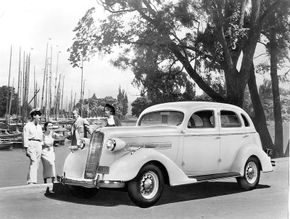
But somehow, Reo managed yet another new Flying Cloud for 1935. Designated A-6, it offered two- and four-door Hayes-built fastback sedans. Wheelbase was 115 inches. The engine was a superior new 90-bhp 228-cid six. It had seven main bearings, an aluminum head, automatic choke, and an external vibration damper. Front styling vaguely recalled Auburn, with flared fenders and a vee’d bumper.
Ransom Olds hated the A-6. He called its $450,000 tooling cost a waste of money.
But as at Olds Motor Works long before, his colleagues disagreed. They pushed ahead for ’36. They were doubtless encouraged by Reo’s first profit in years. It was a slim $42,156 for the first half of 1935 on meager sales of cars and trucks. Still seeking to bolster income, the firm shared its body dies with erstwhile rival, Graham-Paige.
In November 1935, Reo announced “America’s Finest Six.” It was just an A-6 with fuller fenders and rubber-tipped bumper guards. Optional “Zeppelin-style” fender lamps appeared. The reworked hood and radiator wore bright trim a la Pontiac’s “Silver Streaks.” The Self-Shifter was canned for conventional over-drive. It was a $50 extra for standard and DeLuxe models priced at $795-$895.
Public confidence in Reo had nearly evaporated. The firm built a mere 3206 cars that year. Compare that to the 4692 units from calendar-year 1935.
With trucks now far more profitable than cars (the G-P deal had produced little revenue), the Reo board voted on May 18, 1936, to move truck assembly into the main Lansing plant. On September 3rd, Reo officially left the auto business. They lost nearly $1.4 million on their 1936 cars. But they were able to write off $604,000 for terminating those operations. Reo then turned exclusively to the truck field.
Ironically, it would thrive there far longer than it had with cars. Producing for the next 40 or so years under the Reo and Diamond-Reo nameplates.
For more on defunct American cars, see:
-
AMC
-
Duesenberg
-
Oldsmobile
-
Plymouth
-
Studebaker
-
Tucker