It’s another Kia. Again.
Nine SUVs already fill their UK lineup, spanning from the pocket-sized Stonic up to the EV9’s monstrous bulk. Logic says that’s enough. Logic doesn’t work on marketing teams. Enter the second-generation Kia Seltos.
You haven’t heard of it? Normal. The first one launched in 2019, sold heavily in India, Korea, and the US, and never set foot in Europe. Last year, it was Kia’s second-best seller globally, trailing only the Sportage. That’s impressive. The new model lands this autumn to attack the fiercely crowded family SUV sector.
Is it replacing the Sportage? No.
The Sportage stays because it’s bigger, more practical, and sells like hotcakes. Kia hopes the Seltos lives quietly beside it, stealing only a few customers who might otherwise look elsewhere. The real casualties? Likely the XCeed or the Niro. Both have facelifts but no UK confirmation. Both are nearly the same size as this new box. If those two vanish, the choice simplifies. Pick the Seltos for hybrid. Pick the EV3 for electric. Easy enough.
But easy isn’t the word for the competition.
Looks like a Jeep?
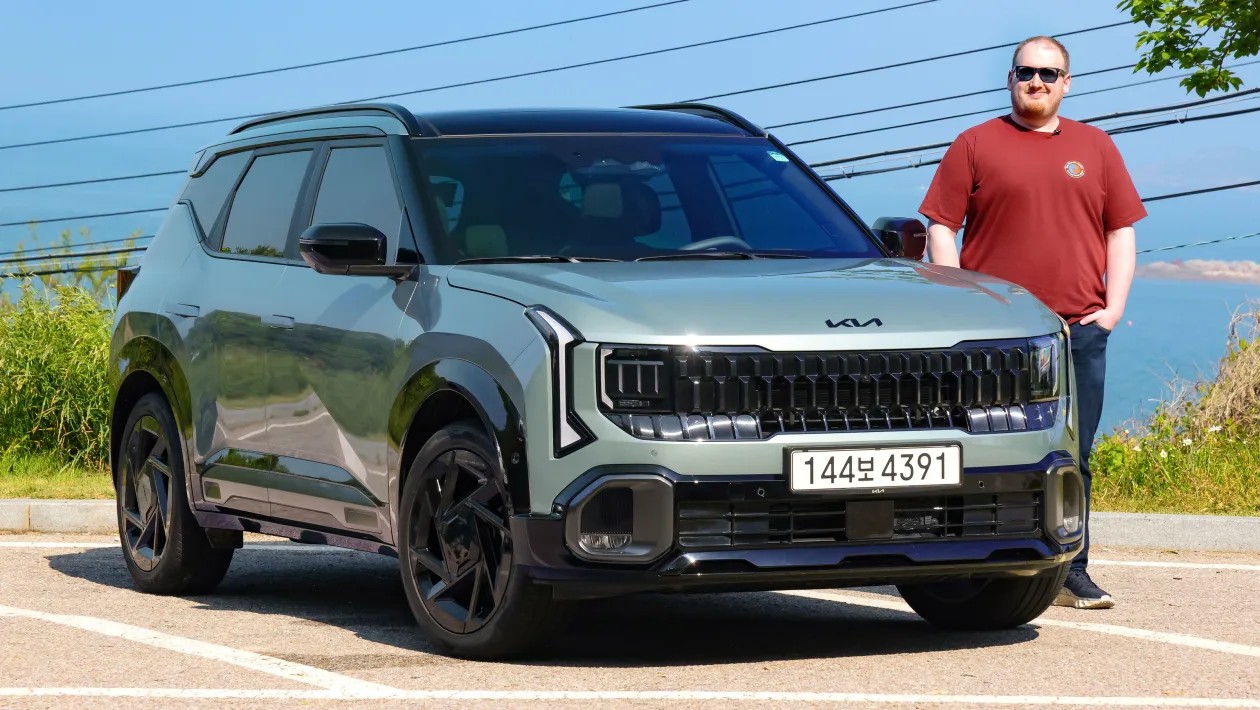
Boxy shape. Tall floating roofline. Bluff front end. It wears its SUV identity loud. The chunky bumpers sport fake skid plates, angular wheel arches widen the stance. If Kia slapped a seven-slot grille on the nose, we’d call it the next-gen Jeep Renegade. It passes for one easily.
Inside, the vibe shifts.
Plushness? Gone. Durability rules here. Physical buttons everywhere. Large toggle switches for climate control sit ready for thumb-smacks while driving. You can see them. You don’t need a magic trick to turn up the heat.
Tech-wise, it mirrors the EV3. A 12.3-inch driver cluster, a matching central touchscreen, and a smaller five-inch panel sandwiched between for climate specifics. Wireless CarPlay and Android Auto are standard.
The screens are sharp, graphics big, the system slick.
The middle screen is useless, though. The steering wheel blocks half the view. And the menus? Deep. Buried. Hunting for Advanced Driver Assistance Settings feels like a job. Good thing there are those shortcut buttons then.
Materials are hard plastic. Almost every surface. But it’s not scratchy cheap black stuff. Different finishes mix things up, metal-effect accents glint on the doors, ambient lighting softens the edges. It feels solid. It feels like it will survive sticky juice and muddy shoes.
Room for everyone?
Yes. Six-foot adults fit in the back without crushing their knees. Isofix points await for child seats. The boot is 536 litres. Bigger than a Qashqai. Bigger than the Kona. Smaller than the Sportage. Underfloor storage adds more, plus mounts for new “AddGear” accessories. It’s functional.
Power? That’s the problem
UK buyers get one powertrain. A full hybrid.
1.6-liter four-cylinder petrol paired with an electric motor and six-speed automatic. 150bhp total. That’s weak. Really weak. The e-AWD version adds a second motor, bumps to 175bhp, and gets slightly faster traction, but the base model struggles. 0 to 62 mph takes 10.4 seconds for front-wheel drive. Sub-10 only if you pay extra for the four-wheel drive setup.
Why? Because the electric motors provide only a shove of about 25bhp. They help off the line. Then the petrol engine wakes up. And screams.
It revs to 5,000 rpm to hit motorway speed. You feel the effort. With two adults and some bags, it groans. Load a family in, add luggage, and it’s stressed. The noise isn’t ear-bleeding bad, just persistent. Unpleasant.
But here’s the twist. The transitions are smooth. Gear changes feel slick, though the box likes to hang onto gears too long when you lift off the throttle. The trick? Lift all the way. The engine shuts off. The car glides. Electric mode. Silent.
We averaged nearly 50 mpg on highway runs. The engine hibernated often. Too often, really. Kia hasn’t published official efficiency figures, which is annoying given the strong real-world result.
Driving experience
Smart regeneration adjusts automatically to traffic, nav data, and road gradient. You can ignore it. Use the steering wheel paddles for four levels of braking strength or coasting mode. Your call.
The steering has weight, but remains light enough for tight car parks. Visibility is good. The boxy shape gives a lofty view. The square bonnet ends abruptly in front, helping judgment of front corners.
Suspension does a job on Seoul potholes. Settles on motorways. Some road noise at speed, zero wind noise despite the brick shape. Not fun on twisties, but composed enough to not embarrass you.
It’s not a sports car. It’s a people mover with hybrid plumbing.
Price will decide fate
Seltos launches in the UK in October. Pricing? Not final. Expecting £30,00 to £32,000 starting MSRP.
Kia needs the lower number. £30k puts it near the Jaecoo 7, that Chinese newcomer stealing hearts. It also puts it under the Qashqai hybrid and the Sportage hybrid by a few grand.
If it starts at £32k? Good luck. People will upgrade. Finance deals favor the bigger car. The Sportage is waiting. It has more space. It looks nicer to many. Why step down?
Two specs expected. A base model and then either an X-Line (rugged) or GT-Line (sporty). We drove the X-Line. It looks chunkier. Better, for the vibe.
The Seltos is a sensible choice if the price stays right. It ticks the boxes. Space. Tech. Comfort. Frugal hybrid. It just has to justify why you shouldn’t buy the other car in the showroom next door.