


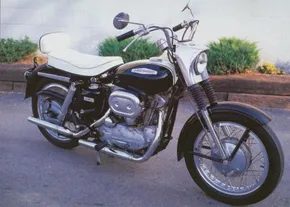
The 1967 Harley-Davidson XLH Sportster was Harley’s “luxury” model for the Sportster line. It had a few key features that set it apart from its siblings, but none were as significant or as controversial as the electric starter. That’s right, the electric starter.
Before we dive into that, let’s talk about the Sportster line in general. The XLH was the top-of-the-line model in the Sportster lineup for 1967. It was designed to appeal to riders who wanted a little more luxury and comfort than the sportier XLCH could offer. The XLCH was still available, but it stuck with a kick starter as its primary means of ignition. That’s right, the sportier of the two models had a kick starter.
Now, let’s get to the electric starter. Harley had been experimenting with electric starters on their Big Twins for a few years now. They’d been introduced in 1965, and they’d gained a lot of popularity. But on Sportsters? Not so much.
The electric starter was only available on the XLH version of the Sportster. The XLCH stuck with a kick starter. It’s interesting to think about why Harley made that choice. Maybe they thought the sportier model didn’t need the extra weight of an electric starter. Or maybe they just wanted to keep the price down for the sportier model.
Whatever the reason, it’s clear that the electric starter was a big deal on the XLH. It was a luxury feature, and it set the XLH apart from the sportier XLCH. And for riders who didn’t want to deal with kick starting their bike every time they fired it up, it was a game-changer.
But let’s not forget the kick starter. It was still there on the XLH, as a backup to the electric leg. And on the XLCH, it was the only way to get the bike started. There’s something to be said for the simplicity and reliability of a kick starter. And for riders who don’t mind a little workout, it’s a great option.
In the end, the 1967 Harley-Davidson XLH Sportster was a motorcycle that offered riders a choice. Did they want the luxury and convenience of an electric starter? Or did they prefer the sportier, lighter feel of a kick starter? Either way, the XLH and XLCH were both great bikes, and both had their own unique appeal.

The XLH: Chrome, Tanks, and Bonneville Glory
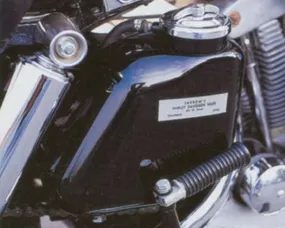
The standard iron was one thing. The XLH was another beast entirely. It carried fancier trim that separated it from the base model. You saw it in the large polished headlight nacelle. It caught the sun. It made the front end look expensive. Then there were the chromed rear shock covers. Shine where others offered rust. And the fuel tank. It was larger. More range. More presence.
Harley-Davidson didn’t just sell bikes in 1967. They sold legends. The ads were loud. They pointed to Bonneville. Salt flats. Record-setting runs. These weren’t stock motorcycles in the traditional sense. They were highly modified machines. Stripped down. Lightened. Tuned to the absolute limit.
But the marketing spin was clever. You could claim speed without technically lying.
“Nobody builds a faster stock motorcycle.”
The line hung there. It was a bold statement. It relied on the audience ignoring the word “highly modified.” It relied on them seeing the brand name and imagining speed. The Sportster had done it. It had broken records on the salt. And if a modified version could fly, the stock version must be fast too.
It was a clever play. The reality was messy. The race bikes were outliers. The showroom bikes were practical. But for 1967, that distinction didn’t matter to the buyer. They just wanted to know Harley built something fast.

Where to Dig Deeper Into Two-Wheel History
If you have already devoured the basics and are hungry for more granular details, the archives offer a specific trail. Start with the core Harley-Davidson Motorcycles section, which breaks down the lineage of Milwaukee’s most iconic machines. It is not just a list of models. It is a timeline of engineering shifts, market pressures, and cultural pivots.
For those who want to understand the mechanics under the hood—or rather, behind the seat—How Harley-Davidson Works provides the technical scaffolding. You will find explanations of engine configurations, transmission quirks, and the specific torque curves that define the riding experience. This is not surface-level fluff. It is the nuts and bolts of why a big twin feels different from a V-twin.
The culture, however, is just as important as the metal. How Choppers Work dissects the custom scene that often rivals factory production in complexity. We are talking about hardtail frames, raked-out front ends, and the geometry changes that make these bikes look fast even when they are stationary. The Chopper Profiles section takes this further by highlighting specific builds that pushed boundaries. These are not just pretty pictures. They are case studies in customization, showing how riders have reimagined the standard template.
For a broader scope, Classic Motorcycles expands the lens beyond Milwaukee. It covers the British twins, the Japanese four-strokes, and the European singles that defined eras before the Harley-dominated garage became the norm. Finally, How Motorcycles Work serves as the universal primer. It explains suspension kinematics, braking systems, and electrical architecture across all makes.
The rabbit hole is deep. You can spend weeks tracing the evolution of a single carburetor design or a specific frame geometry. The history is written in steel and gasoline. Keep digging.


