


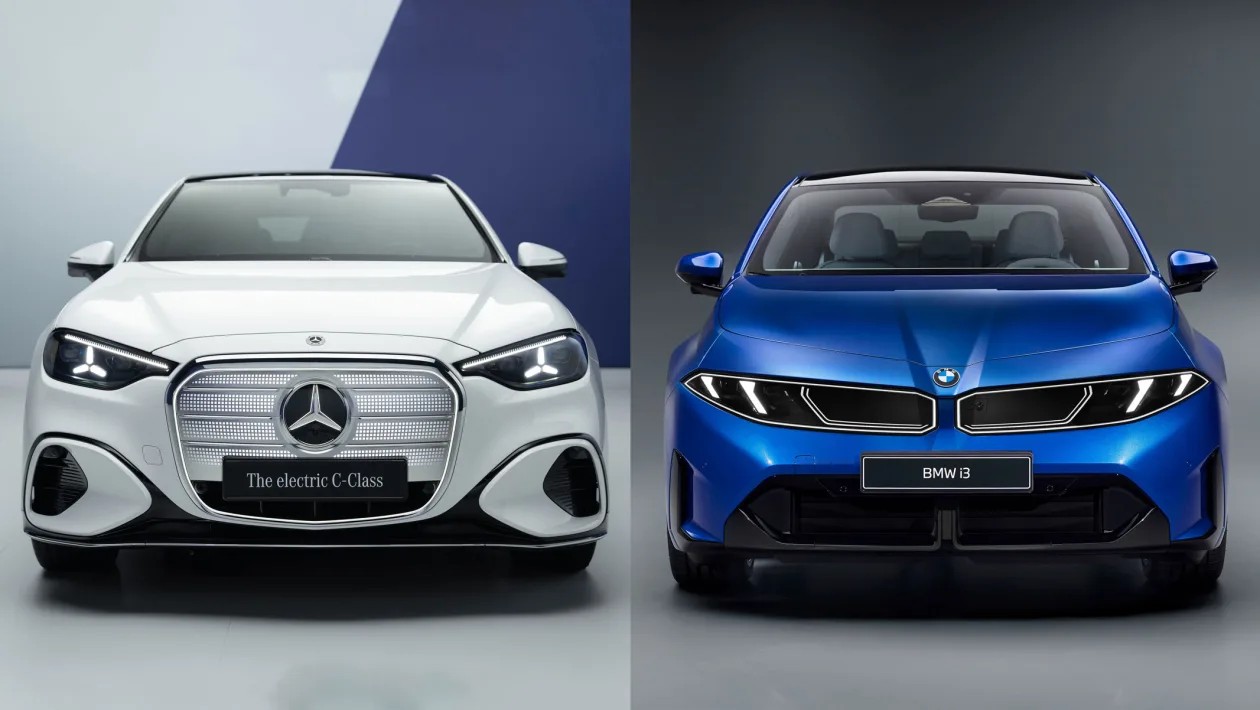
The legendary rivalry between Mercedes-Benz and BMW is entering a new era. As the automotive industry pivots toward full electrification, the competition has shifted from internal combustion engines to battery chemistry and software. Both manufacturers have recently unveiled their next-generation electric executive saloons: the Mercedes C-Class Electric and the BMW i3.
To understand which vehicle leads the pack, we look at their top-tier, long-range, dual-motor variants, which are positioned at similar price points.
Range and Efficiency: A Battle of Capacity vs. Consumption
On the surface, the BMW i3 appears to be the clear winner regarding distance. Equipped with a massive 112kWh battery, the i3 boasts a WLTP-rated range of 559 miles. In contrast, the Mercedes C-Class Electric utilizes a slightly smaller 94.5kWh battery, providing a range of 472 miles.
However, a deeper look at efficiency reveals a different story. When calculating miles per kilowatt-hour (kWh), both vehicles are virtually identical:
– BMW i3: ~4.99 miles/kWh
– Mercedes C-Class Electric: ~4.99 miles/kWh
This parity suggests that despite the BMW having a much larger battery, both cars are engineered with nearly identical levels of energy efficiency. The BMW’s superior range is a result of raw capacity rather than a technological breakthrough in energy conservation.
Charging Performance: Speed and Convenience
Charging speed is a critical metric for EV adoption, as it dictates how much “downtime” a driver experiences during long trips. Here, the numbers favor BMW:
- Maximum DC Fast Charging: The BMW i3 can handle up to 400kW, while the Mercedes C-Class Electric peaks at 330kW.
- Rapid Replenishment: In a 10-minute charging window, the BMW adds approximately 248 miles of range. Mercedes provides a different metric, stating that 10 minutes of charging adds 198 miles of range.
While Mercedes’ charging is still highly competitive, BMW’s higher peak intake offers a slight edge for drivers prioritizing rapid turnaround at ultra-fast charging stations.
Performance and Power: The Mercedes Edge
While BMW wins on endurance and charging, Mercedes-Benz maintains its reputation for driving dynamics and raw power.
The C-Class Electric’s dual-motor setup produces 482bhp, outperforming the BMW’s 462bhp. This extra power translates to acceleration; the Mercedes can sprint from 0–62 mph in just 4.1 seconds. While the exact 0–62 mph time for the BMW i3 has not been officially confirmed, estimates suggest it will sit around the 4.4-second mark, making the Mercedes the faster machine on paper.
Comparison Summary
| Feature | Mercedes C400 4Matic | BMW i3 50xDrive |
|---|---|---|
| Battery Size | 94.5kWh | 112kWh |
| Range (WLTP) | 472 miles | 559 miles |
| Max DC Charging | 330kW | 400kW |
| Range added in 10 mins | 198 miles | 248 miles |
| Power | 482bhp | 462bhp |
| 0–62 mph | 4.1 seconds | ~4.4 seconds |
Conclusion
On paper, the BMW i3 holds the advantage in the most critical EV metrics: total range and charging speed. However, the Mercedes C-Class Electric remains a formidable opponent by offering superior power and acceleration. Ultimately, while BMW wins the statistical battle, the true victor will be determined by how these vehicles feel on the road.
The Verdict: If your priority is maximum distance and rapid charging, the BMW i3 leads the way; if you crave performance and raw power, the Mercedes C-Class Electric takes the prize.


