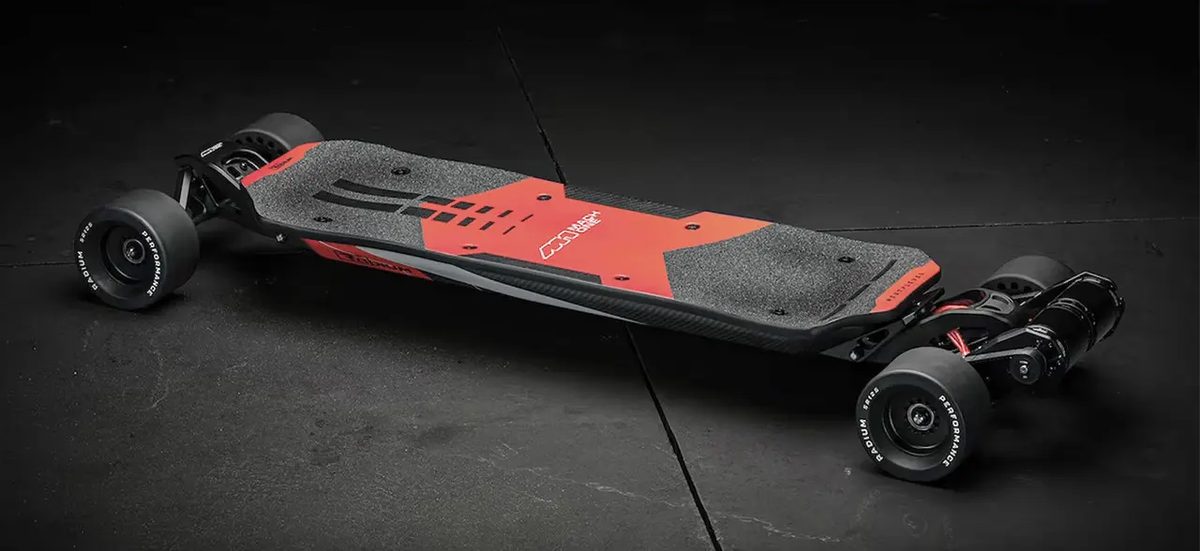
72 kilometers per hour. That isn’t a typo. It’s the top speed of the Mach One XP3, a prototype electric skateboard built by Australian startup Radium Performance. This isn’t some glossy retail toy for weekend strollers. It is a machine that took four years of development to get right. The goal? To deliver insane velocity for riders who actually care about numbers.
The specs are aggressive. Eight thousand watts of power. Zero to 48 kilometers per hour in three flat seconds. That is supercar territory, just on wheels. The engineering draws direct inspiration from Formula 1. You get a hollow carbon fiber chassis tied directly into the suspension system. The battery and all the electronics live inside this cavity. It keeps weight low and center of gravity even.
Accessing the guts is surprisingly simple. Eight bolts hold the deck to the frame. Remove them and you can swap the battery or do maintenance without cutting wires. But you probably won’t need to touch anything. Radium includes a mobile app for tuning. Why risk voiding warranties or messing up alignment when you can adjust vectoring from your phone?
“The first torque vectoring system in the world on an electric skateboard.”
This claim isn’t marketing fluff. It is the core technological leap here. Most electric skateboards struggle with stability at high speeds. The Mach One solves this by distributing torque independently to each wheel. This allows for sharper cornering and immediate responsiveness. You turn harder, you react faster. The motors connect to the wheels via urethane belts reinforced with steel fibers. They handle the torque without snapping under pressure.
Power comes from a 48-volt, 1,089 Wh battery pack. It gives you about 48 kilometers of range. Not enough for a cross-country commute, but plenty for a serious session. Charging hits 90% in two hours. The whole rig weighs 17 kilograms. Manageable, but heavy enough to demand respect.
Ownership costs are steep, though. The early bird price is 5,298 Australian dollars. That converts to just under 3,000 euros. But this deal is capped at the first 100 orders. If you miss the cutoff, the price likely jumps. It is an investment in hardware that pushes past standard recreational limits.
Legal reality check though. You cannot ride this on public roads in France. Or most of Europe. Regulations cap personal mobility devices at 25 kilometers per hour. This beast would be illegal street-legal everywhere in the EU without modification. It belongs on private tracks, closed courses, or somewhere with no speed limits and no police.
Why build a skateboard that goes twice as fast as the legal limit? Because engineering doesn’t always bow to bureaucracy. Radium is proving that electric mobility can be thrilling, not just convenient. The torque vectoring tech alone could trickle down to other vehicles. Better handling. Safer corners. The rest is just speed.
Who is this for? People who want more than a commute tool. It is for enthusiasts willing to pay a premium for carbon fiber and independent wheel control. The price reflects the tech, not just the materials.
The market for high-performance electric skateboards is niche. Very niche. But the gap between “fun” and