It started with noise. Specifically, the collective noise of European editors who have been judging cars since 1964. The lineage traces back to Automobile Magazine in France and a handful of other continental publications. Their job? Pick the best new car hitting the market. They don’t guess. They drive. They break things down. They argue. Then they score.
For the 2026 cycle, 60 journalists took the wheel. Six of them were French. They looked at 36 contenders. The field ranged from the entry-level BYD Dolphin Surf to the massive Hyundai Ioniq 9. You had the sleek Audi A6 e-tron. You had the revived Nissan Leaf. It was a chaotic mix of ICE hybrids and pure EVs.
Who Made the Cut?
The jury didn’t pick winners on day one. They whittled it down. By last October, only seven cars remained. Two of them were French. That’s rare. Usually, the continent’s carmakers struggle to make the shortlist against German engineering or Japanese reliability.
The announcement happened at the Brussels Motor Show. The tension was palpable. The drumroll was long. When the envelope opened, the winner wasn’t a French favorite. It wasn’t even a crossover.
The Mercedes CLA Takes Top Spot
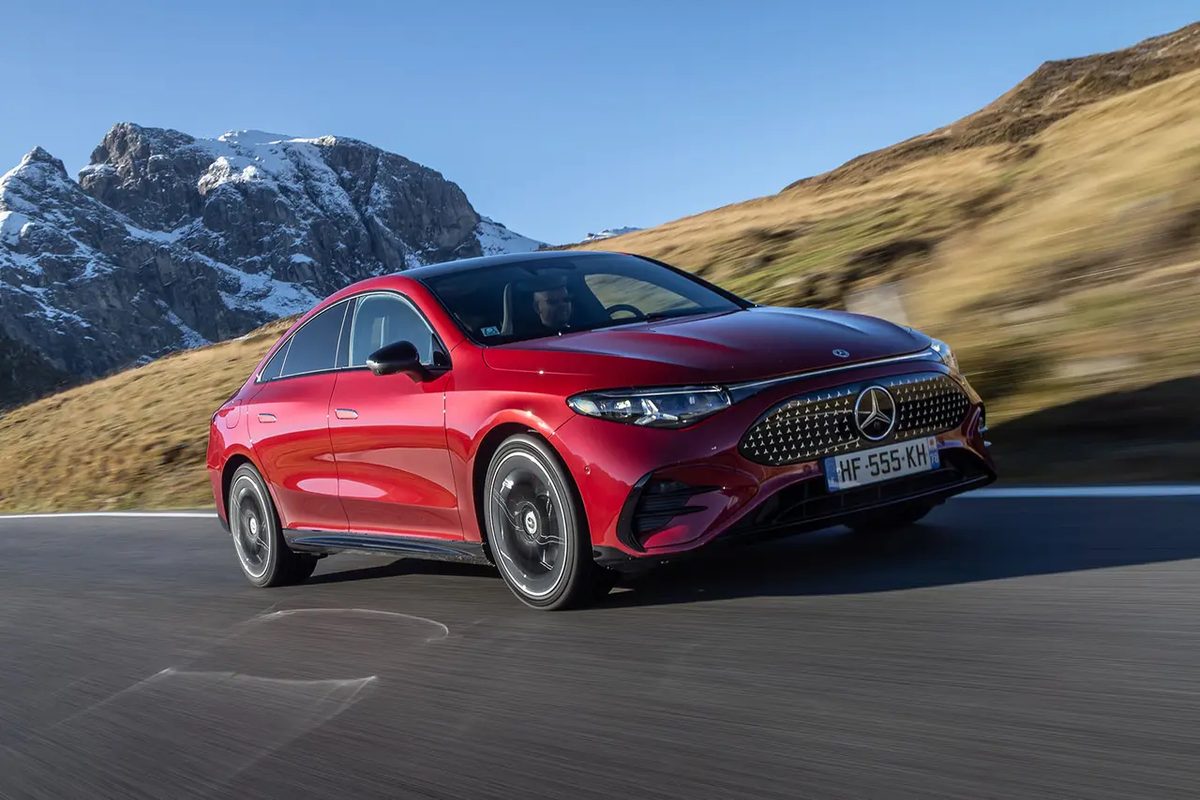
The Mercedes CLA is the 2026 European Car of the Year. It didn’t just win. It dominated.
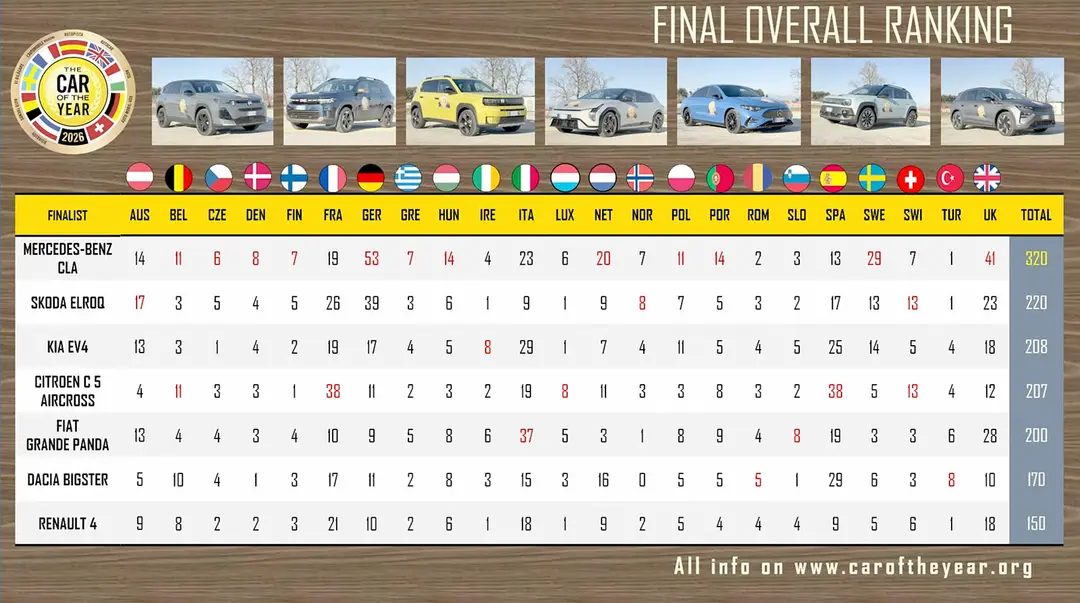
The scoring system is brutal. You need volume to win. The CLA scored 320 points. That is a massive number. It wasn’t close. The second-place car, the Skoda Elroq, managed 220 points. That’s a 100-point gap. In car judging, that’s an eternity. The third spot went to the Kia EV4 with 208 points.
“The Mercedes CLA didn’t just take the crown. It left the competition in the dust.”
French Cars Struggle for Respect
This year was bad for France. Really bad.
Look at the recent history. In 2024, the Renault Scenic e-Tech won. In 2025, the Renault 5 e-Tech won. The French group was on a roll. They had momentum. They had hype.
But 2026 was different. The Dacia Bigster was considered a favorite. It didn’t even make the podium. It finished sixth with 170 points. The Renault 4 e-Tech finished seventh with 150 points.
Why did the French struggle?
Maybe the jury is tired of small electric hatchbacks. Maybe they wanted something different. The Mercedes CLA offers a different proposition. It’s a coupe. It’s stylish. It’s practical enough. It’s not an SUV. It’s not a boxy EV. It’s a traditional sedan shape with electric teeth.
Why This Matters
The Skoda Elroq finished second. That’s significant. Skoda is often seen as the sensible choice. The practical family hauler. But here, it lost by a landslide. The Kia EV4 also
Why the new Mercedes CLA MMA platform matters
It’s been half a century since Mercedes last took the top spot here. The previous win went to the W116 S-Class back in 1974. Is the new CLA’s victory deserved? That depends on who you ask. The judging criteria vary wildly. One thing is certain though. Its tech stack tipped the scales heavily.
The car sits on a fresh multi-energy architecture called MMA. You can get it as a hybrid or fully electric. Usually, this kind of flexible setup limits drivetrain efficiency. Not here. The potentiometers are pushed to impressive levels. Energy sobriety and battery tech are leading the pack.
Aerodynamics play a huge role. The sedan measures 4.73 meters long. Its drag coefficient sits at a slick 0.21. Mercedes sculpted the silhouette to minimize air resistance. It helps with consumption figures. They also installed next-generation electric motors. An unusual two-speed gearbox helps too. It reduces energy appetite at high speeds.
Under the floor lies an 800V battery architecture. This allows for charging speeds up to 320 kW. Real-world scenarios might even push higher. That makes it one of the few EVs offering thermal-like versatility on the highway. We’ll dig into the numbers soon.
Pricing starts at €52,900 for the CLA 250+. It comes with an 85 kWh battery. WLTP range hits 791 km. That’s serious range for a compact coupe. A wagon version has also joined the lineup.
“It is, at this point in time, one of the electric cars that offers the same level of versatility as a thermal engine on the motorway.”