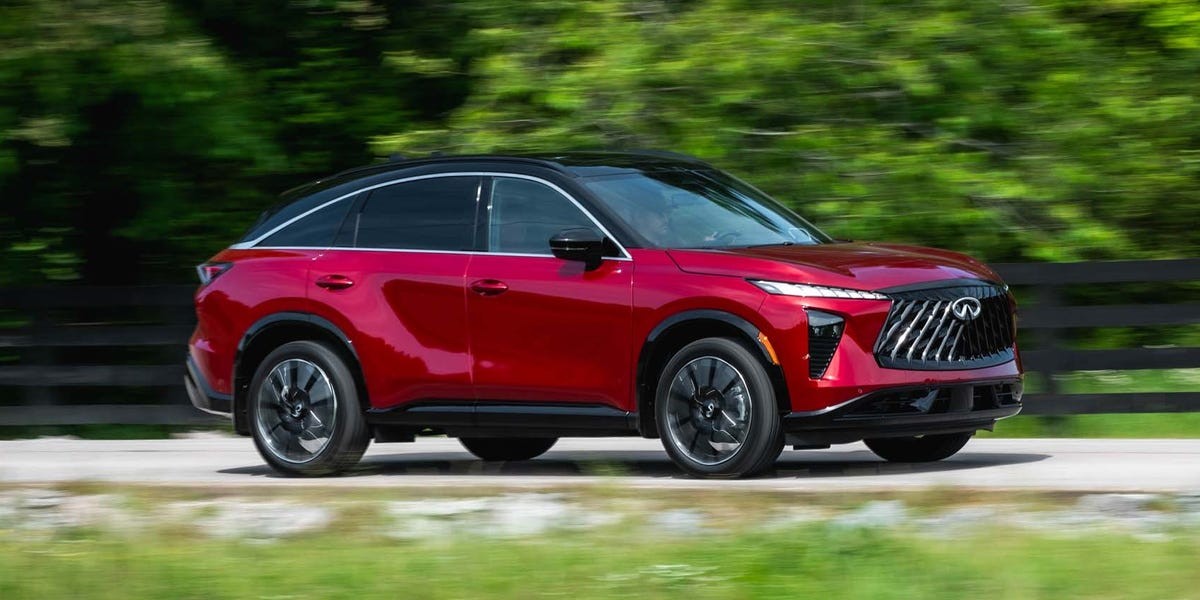
Infiniti is attempting a nostalgic comeback by reviving a design philosophy that once defined the brand: the aggressive, “coupe-like” SUV silhouette. The 2027 QX65 arrives as a sleeker, more stylized sibling to the three-row QX60, clearly drawing inspiration from the cult-classic Infiniti FX. However, while the QX65 succeeds in capturing a certain aesthetic, there is a growing disconnect between its sporty appearance and its actual driving dynamics.
Design and Interior: Style vs. Substance
The QX65 distinguishes itself from the standard QX60 through a more dramatically tapered rear end. While the design uses clever visual tricks—such as a chrome trim line that dips lower than the actual roofline—to create a sense of motion, it comes at a practical cost. By opting for this “SUV coupe” shape, Infiniti has sacrificed utility:
– Reduced Cargo Space: The QX65 offers 36 cubic feet of space behind the second row, which is six cubic feet less than its sibling.
– Lost Versatility: The tapered roofline eliminates the third-row seating option found in the QX60.
Inside, the cabin follows the QX60’s layout, featuring a sweeping, multi-textured dashboard. While the layout is modern, the execution feels inconsistent. High-end surfaces are frequently interrupted by hard plastics on the lower door panels and around the center console, creating a mixed sense of luxury that feels somewhat unrefined for its price bracket.
Performance: The Complexity of the VC-Turbo
Under the hood, Infiniti utilizes Nissan’s sophisticated VC-Turbo technology. This 2.0-liter inline-four engine features variable compression, allowing the pistons to adjust their stroke to balance power (268 hp) and efficiency.
However, there is a fundamental mismatch between the engine and the vehicle’s mass. The top-tier Autograph trim weighs an estimated 4,715 pounds, a heavy load for a four-cylinder engine. This weight penalty results in modest fuel economy, EPA-estimated at 20 mpg in the city and 26 mpg on the highway.
The “Sporty” Illusion
The most controversial aspect of the QX65 is its attempt to manufacture a sporty feel through software rather than hardware. This is most evident in two areas:
- Synthesized Sound: To mask the four-cylinder engine note, Infiniti uses “V-6 engine harmonics”—artificial sounds piped into the cabin to mimic a larger engine. This feature cannot be turned off, which may grate on drivers seeking a natural driving experience.
- Aggressive Tuning: The accelerator has been tuned for a “snappier” response, which can make low-speed driving feel jumpy. Additionally, in Sport mode, the transmission tends to hold gears too long, contributing to a noisy, droning cabin environment.
Despite these quirks, the QX65 shines in Comfort mode. The ride is supple and smooth, aided by effective active noise cancellation that creates a quiet, Lexus-like atmosphere. Practical touches, such as a cooled inductive phone charger and generous storage cubbies, also add to the daily usability.
Market Positioning and Value
The QX65 enters a crowded luxury segment, and its pricing presents a significant challenge for buyers:
- Entry Level: The base Luxe trim starts at $55,535, making it competitive with the Lexus RX and Lincoln Nautilus.
- High End: As options are added, the price climbs rapidly. A fully equipped Autograph model can easily exceed $71,000.
At this higher price point, the QX65 faces stiff competition. For roughly the same amount, buyers can opt for a BMW X5 or a Genesis GV80, the latter of which offers a more powerful twin-turbo V-6 engine that provides the genuine performance the QX65 only simulates.
Conclusion: The 2027 Infiniti QX65 is a stylish, comfortable cruiser that excels in a relaxed setting. However, those looking for a true performance SUV may find that its sporty aesthetics are more about “smoke and mirrors” than actual driving thrill.