Every single day, between 3,000 and 15,000 heavy-duty trucks converge on the Port of Santos in Brazil. They wait for their cargo. Then they endure two hours of treacherous, mountainous driving to haul goods up to São Paulo. It is a logistical bottleneck that drains time, money, and patience.
Now, researchers at Brazil’s Federal University of Santa Catarina (LabTrans) and port logistics firm EGA Group want to slash that commute to 20 or 30 minutes. They are betting everything on Hyperloop Transportation Technologies (HTT) and a concept that many wrote off as dead. The goal? Move up to 5,600 capsules daily at speeds nearing 600 km/h.
This isn’t just about speed. It’s about surviving the economics of global trade.
How the HyperPort System Works
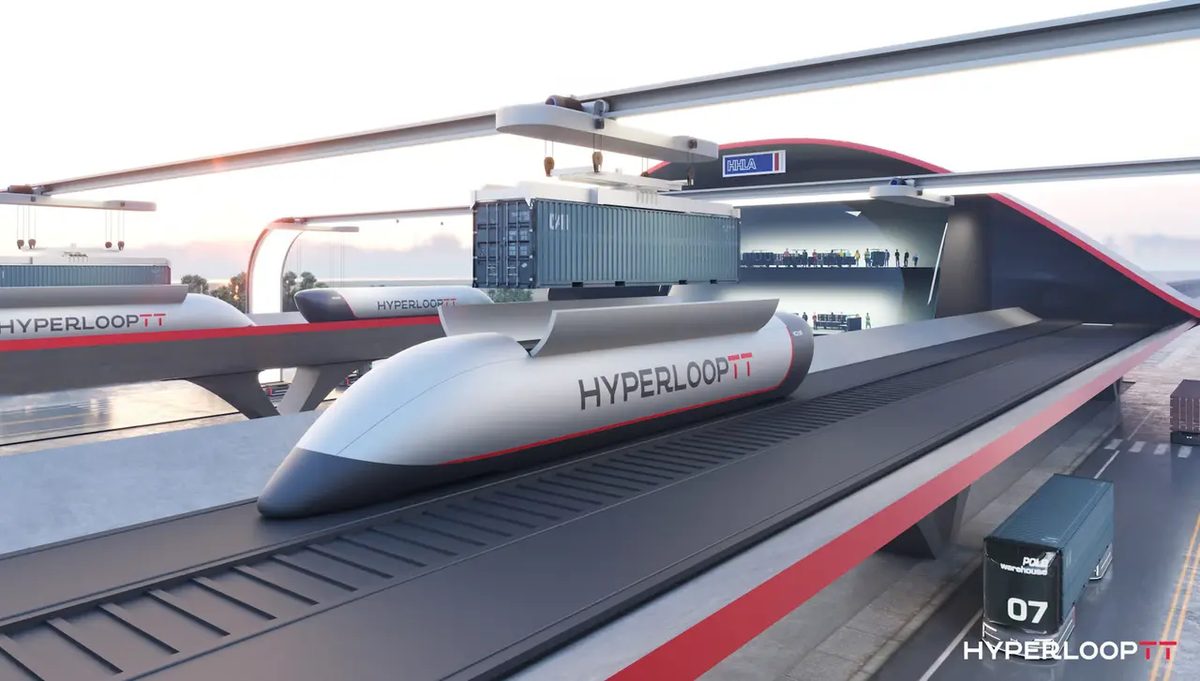
The plan is specific. A station called HyperPort would sit directly on the port zone. Containers would be locked inside pressurized capsules. These capsules shoot out into a tube system.
The preliminary study outlines exact capacity numbers. The line needs to handle 4,810 capsules traveling between São Paulo and Santos. Another 4,156 capsules would run between São Paulo and Campinas, a city further inland.
Critically, this configuration changes the viability equation. Previously, the Hyperloop Santos São Paulo freight system was viewed as economically unfeasible. This new data suggests otherwise. The math actually works.
The Economic Case for High-Speed Freight
HTT is highlighting the obvious benefits. A total line length of 169 kilometers would remove up to 4,000 trucks from Brazilian roads every day.
Fewer trucks means less pollution. Fewer trucks mean fewer accidents on dangerous mountain passes. But money talks louder than safety statistics.
The entry cost is steep. Building the vacuum tubes and supporting infrastructure requires nearly €9 billion. Operational costs are estimated at €1.45 billion annually.
“For HTT, the deal could be lucrative because total envisioned revenue could exceed €15.6 billion.”
That is a massive return on investment. If the numbers hold up, the project pays for itself many times over. But here is the catch. This is only a preliminary study.
The Technical Cliff
We have seen this movie before. The Hyperloop concept has repeatedly morphed into a fiasco. Why? Because technical constraints are unforgiving.
Maintaining a near-vacuum environment over 169 kilometers of terrain is hard. Managing thermal expansion in long tubes is harder. Keeping the capsules suspended and stable at 600 km/h requires engineering precision that current technology has not fully demonstrated.
The financial model is sound. The logistical need is desperate. But the physics haven’t changed. Can you build a reliable tube long enough and strong enough to handle this volume without constant catastrophic failure?
We don’t know yet. The study says yes. The engineers are still skeptical. Until those tubes are actually sealed and pressurized, this remains a fascinating spreadsheet exercise. One that happens to involve billions of euros and the fate of Brazilian logistics.