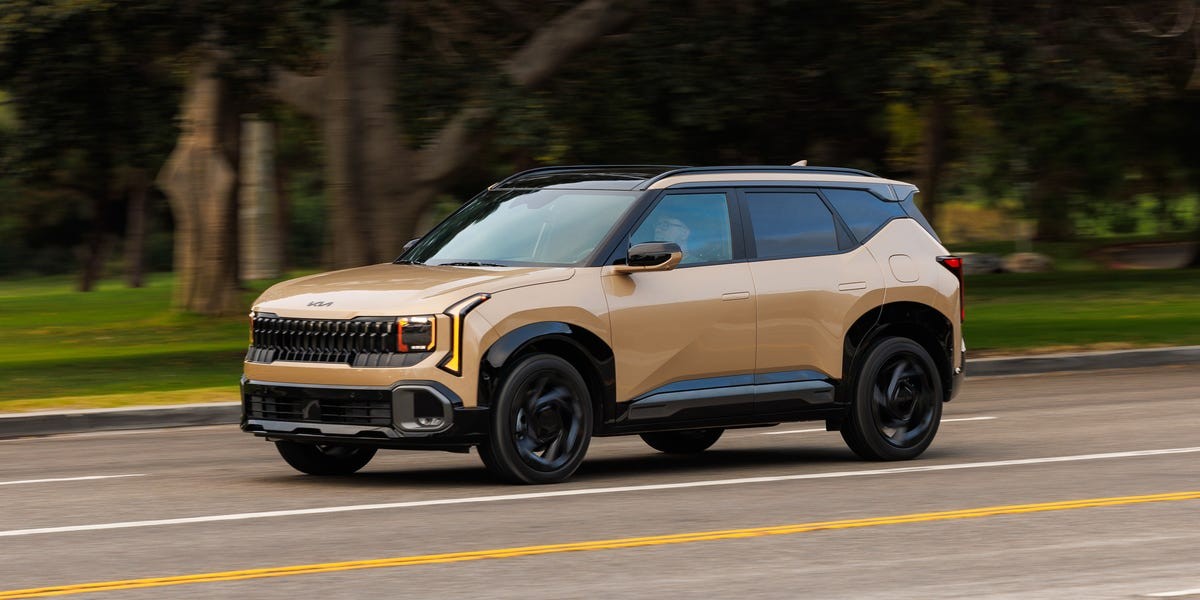
Kia did something unexpected with the 2027 Seltos. It stopped trying to be the anonymous bargain basement option and became a shrunken Telluride. The second generation is sharper. Cleaner. It looks like a proper upgrade. But appearances can be deceiving. There is actual substance here. The cabin is better. The ride is softer. It feels like a step up in class.
That isn’t to say the package is perfect.
Interior Space and Design Shifts
The exterior has grown. Subtly. But it matters.
The new Seltos is 1.8 Inches longer. Just over an inch wider. Almost an inch taller. But the wheelbase? That jumped by 2.4 inches. That stretch does wonders for the interior. Rear legroom is now 39 inches. That is a full inch better than before. Class-leading territory. Shoulders are wider too. Cargo space gained a cubic foot. You can actually spread out.
It feels less cramped. Less like an economy hatchback stretched into a box. It feels like a real compact SUV.
Ride Quality and Handling Improvements
Kia engineers tuned the suspension differently this time. Front struts and rear multilink arms use passive dampers. No active electronics. Yet. The result feels like it has computer-controlled damping. Why? Because body motion is smooth. Impacts are eaten up nicely. It has a suppleness that belies its price tag.
Noise levels are lower inside. The steering reacts in sync. Solid chassis feedback. But here is the catch. It doesn’t want to dance. Cornering feels less eager than the previous generation. It is not bad. It is just… content. Less aggressive. But given how much better it rides, we accept the trade-off. Comfort over chaos.
Powertrain Issues and Weight Penalty
This is where the story gets complicated. The engines didn’t change. They are carryovers. A hybrid version comes later, but that’s not relevant to this test.
Base model: 2.0-liter inline-four. 147 horsepower. CVT transmission. Boring but efficient.
Test vehicle: Turbocharged 1.6-liter inline-four. 190 horsepower. 8-speed automatic. Better. But not significantly different from before. The final-drive ratio shifted from 3.51 to 3 65:1. That offset the switch to larger 19-inch tires. Net result? A wash.
So why does it feel slower?
Weight.
Our test X-Line SX AWD model tipped the scales at 3,668 pounds. That is 336 pounds heavier than the last Seltos. Roughly a 10% increase. Power stayed flat. Math is cruel. Each horsepower now hauls 19.3 pounds. Before, it was 17.3.
0 to 60 mph took 8.2 seconds. Previous car: 7.1 seconds.
Quarter-mile? 16.4 seconds at 7,100 feet. Previous: 15.5. Slower. Noticeably slower.
Is it terrible? No. The Chevy Trax—the segment winner in previous comparisons—did 0-60 in 8.5 seconds. So the Seltos sits in the middle. Not a dealbreaker. Just disappointing.
Dynamics and Braking Changes
The extra metal hurts handling grip. The old Seltos managed 0. 83 g on the skidpad. This one? 0.78 g. Same Kumho tires. Same width. But heavier. Less stick. It’s a tragedy in the sense that performance suffers without added power. But it’s not a tragedy in the sense that it drives safely.
Stopping distance? Worse. 70-0 mph took 181 feet. Previous car: 162 feet. That is a hard number to swallow. Brakes feel good normally. But in panic stops, they are less confident.
Features and Efficiency
What do you get for that extra weight? More equipment.
Our tester was an X-Line SX AWD. It came with a full panoramic sunroof with a power shade. New feature. Nice touch. We also got ventilated front seats. Harman/Kardon audio. Eight speakers. External amp. Subwoofer. All part of the Prestige package.
The tech stack is solid. 12. 3-inch touchscreen. Standard wireless Apple CarPlay and Android Auto. Surround-view monitor included. It feels premium. More so than the last time.
And fuel economy? This is the weird part.
How did Kia gain 3 mpg on the highway while adding 336 pounds? We have no explanation. It defies physics slightly. EPA ratings are now 24 mpg city / 30 mpg highway. City figures are unchanged. Highway is up. We will put it through our rigorous 75-mph test to see if real-world matches the EPA. The upcoming hybrid should crush these numbers, but those specs are missing.
Pricing and Verdict
The non-hybrid 2027 Seltos is available now.
Our fully loaded X-Line SX AWD tested for $37,250 total. Base price $34,285. Prestige package added $2,500. Minor extras added $465. It is getting expensive.
But there are lower trims. The LX FWD starts at $26,485. Four levels below the top. The entry point remains accessible. The top end? Aspirational.
The 2027 Seltor is a glow-up. Visually. Comfort-wise. Tech-wise.
But that weight. It drags the performance down. And the brakes.
Is it a better car? Yes. Do we want to drive it hard? Not particularly.
Maybe that’s fine. Maybe this segment has moved on from “fun” to “fine.” And for most buyers, fine is exactly what they want.