You’re bored. The commute is long. Your eyes are glued to the screen for a crucial plot twist in your show, and that red light ahead feels like a personal insult. Forget safety. Forget laws. Just let the car handle it.
But before you start jailbreaking your infotainment system, take a breath. Audi is actually building Project Traffic Light Online to solve the exact problem you’re complaining about, but in a way that keeps you alive.
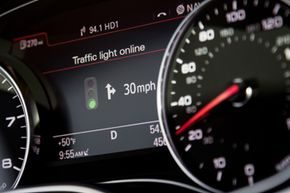
The concept is simple but clever. Audi’s Audi connect Online system talks directly to a city’s central traffic computer. It doesn’t guess. It knows. If the light at the next intersection is green but about to flip to yellow, your instrument cluster will flash a message. You might think the speedometer and tachometer are useless, but this data sits right between them. It tells you if you can make the light or if you need to lift off the gas now.
It’s not just about avoiding tickets. The system also anticipates red lights. If it knows a red is about to turn green, it preps the engine seconds before the change. This makes start-stop technology feel less like a jerky interruption and more like a smooth glide. You save time. You save fuel. You stay awake.
Why This Isn’t Just a Gimmick
This isn’t magic. It’s data. And getting that data is the hard part.
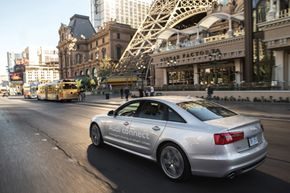
Audi is testing this Traffic Light Online system in Las Vegas. They had to get permission from the Regional Transportation Commission of Southern Nevada to tap into the grid. Nevada is already friendly toward autonomous testing, so the bureaucracy was manageable. But the technical hurdles are real.
Michael Zweck, Audi’s electronics engineer, pointed out the nightmare of scale. For a nationwide rollout, Audi would need to contact more than 500 independent agencies. Each city runs its own traffic signals. None of them use the same data format. There is no standard.
“For a nationwide rollout, we will have to contact more than 500 independent agencies.”
Until that standard exists, Project Traffic Light Online stays local. It’s a pilot program. A proof of concept. But it proves that your car can see what you can’t, without taking your hands off the wheel.
Saving Fuel by Skipping the Stop
Let’s be honest. Most drivers are terrible at reading traffic signals. They treat green lights like suggestions. But Audi’s Project Traffic Light Online does something quietly clever for the people who just want to get there without wasting gas.
Starting and stopping is expensive. Every time you mash the brake, you burn fuel. Every time you accelerate from zero, you burn more. Cruising at a steady 25 mph or 65 mph? Much more efficient.
The system calculates an optimal speed. It tells you to roll in at 32.7 mph (52.6 km/h) to hit a string of green lights. No stopping. No speeding up late at the last second. Just momentum. This is what Audi engineer Zweck calls “improving fuel efficiency.” It’s really just about not wasting energy on unnecessary stops.
Smoothing the Flow
The second benefit is less about your wallet and more about the headache of traffic jams. If everyone hits the lights at the right speed, the whole street flows better. Fewer red-light waits. Fewer pile-ups that block intersections.
But here’s the question: what if only a few cars have this tech? Won’t the uncooperative drivers ruin it for everyone?
Zweck says no. Research shows that improved traffic flow kicks in when just 5 to 10 percent of vehicles use the system. That sounds small. But in 2013, there were nearly 250 million cars on the road. 5 percent of that is 12.5 million cars talking to traffic signals. That’s enough to make a difference.
Not Self-Driving, But Getting There
This feels like a step toward the driverless cars we’ve been promised for decades. But it’s not the same thing. Audi’s self-driving A6 Avant, which made waves at the 2013 Consumer Electronics Show, is a separate project. Project Traffic Light Online is an assistive tool. It doesn’t drive the car. It just tells you how fast to go.
“We’ve seen test cars in a handful of cities worldwide.”
There are no plans to put red-light reading Audis in showrooms just yet. You can’t buy it. You can only watch.
For now, the system exists to test whether we can actually coordinate with infrastructure. Whether we can stop treating traffic lights as enemies and start treating them as partners. The tech is ready. The cars are ready. The question is whether we’ll ever learn to drive in sync.
We’ll see.